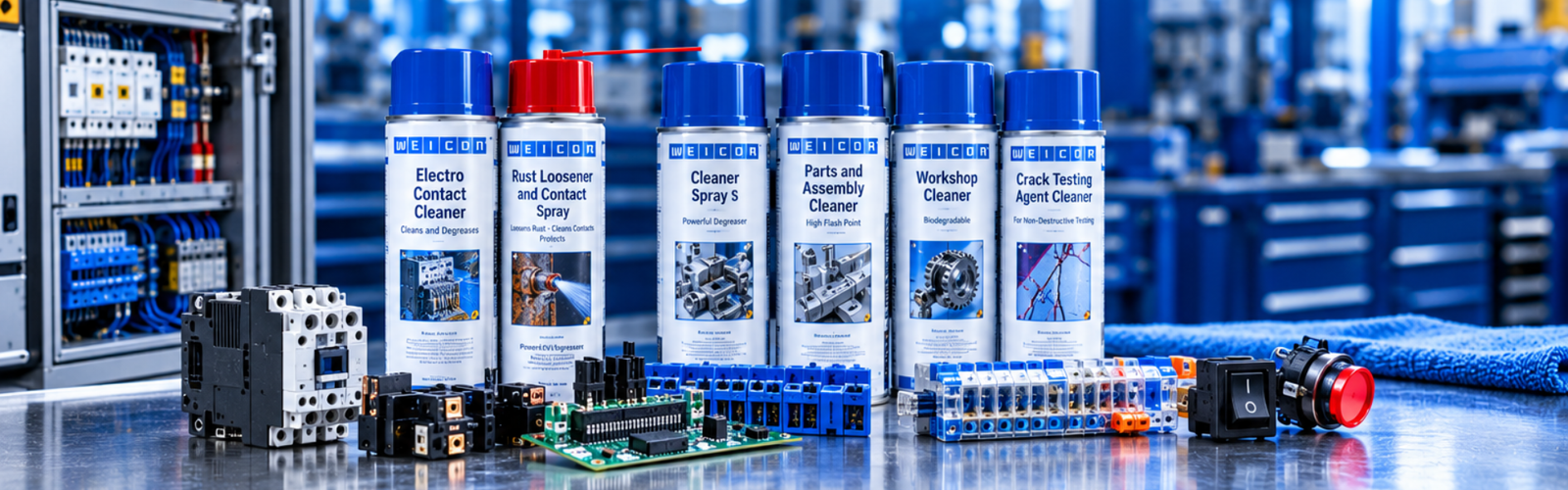
Contact Cleaner: What Is It and When Should You Use It?
Admin
|
09 Oct 2026
|
18 min read
|
50 views
Contact Cleaner: What Is It and When Should You Use It?
Electrical and electronic equipment depends on clean, reliable connections.
From industrial control panels and electrical machines to switches, sensors, relays, connectors and terminals, electrical contacts need to maintain a reliable connection for equipment to operate correctly.
Over time, however, contacts and components can become contaminated.
They may be exposed to:
- Dust
- Dirt
- Oil
- Grease
- Moisture
- Oxidation
- Sulphide deposits
- Environmental contaminants
- Combustion residues
- Resinous deposits
This contamination can affect electrical performance and may contribute to problems such as increased contact resistance, voltage loss or unreliable operation.
This is where contact cleaner becomes an important maintenance product.
A contact cleaner is a specialised cleaning product designed for appropriate electrical or electronic components. Depending on the formulation, it can remove contaminants from contacts and components while evaporating rapidly and leaving little or no residue.
WEICON, for example, offers Electro Contact Cleaner, which is specifically designed for cleaning and degreasing electrotechnical and mechanical components. Its documented applications include electrical machines, measuring instruments, tools, switches, sensors, electrical connections, contacts, relays and switchboards.
But contact cleaner is not simply "a spray for anything electrical."
Choosing the right product, applying it correctly and following electrical safety procedures are all essential.
What Is Contact Cleaner?
Contact cleaner is a specialised cleaning product used to remove contamination from suitable electrical and electronic contacts and components.
Contact cleaner sprays are typically formulated to:
- Remove dirt
- Remove oil and grease
- Remove oxidation-related contamination
- Remove residues
- Clean electrical contacts
- Clean suitable mechanical components
- Evaporate quickly
- Minimise residual contamination
The exact formulation varies between products.
Some are designed primarily for cleaning and degreasing.
Others may also provide protection and care for electrical contacts.
This distinction is important.
Contact Cleaner vs Contact Spray
The terms contact cleaner and contact spray are sometimes used interchangeably, but they can describe different product functions.
A contact cleaner is primarily intended to clean and degrease suitable electrical or electronic components.
A contact spray may be designed more toward protection, moisture displacement and care of electrical contacts.
WEICON's portfolio illustrates this distinction.
Its Electro Contact Cleaner is described as a cleaner for electrotechnical or mechanical components.
WEICON Contact Spray, on the other hand, is described as a product for the protection and care of electrical contacts and is designed to displace moisture and help protect contacts.
Therefore:
Cleaner = primarily cleaning
Contact spray = protection/care functions depending on the product
Always check the specific product's technical documentation.
Why Do Electrical Contacts Need Cleaning?
Electrical contacts need a clean interface to maintain reliable electrical performance.
Contamination can build up from the surrounding environment.
For example:
Industrial machinery
Dust, oil and manufacturing contaminants can accumulate around electrical components.
Outdoor equipment
Moisture and environmental exposure can affect contacts.
Automotive equipment
Oil, dirt, moisture and environmental contamination may reach connectors and electrical components.
Workshop equipment
Dust, grease and other contaminants can accumulate over time.
Control panels
Industrial environments can expose electrical components to airborne contaminants.
Regular inspection and appropriate cleaning can therefore form part of an electrical maintenance program.
What Happens When Electrical Contacts Become Dirty?
Contamination can interfere with the intended electrical connection.
Depending on the component and contamination, potential issues can include:
- Increased contact resistance
- Voltage loss
- Unreliable connections
- Intermittent operation
- Signal problems
- Equipment malfunction
WEICON states that its Electro Contact Cleaner removes contamination including oxide/sulphide layers and other residues, and is intended to help reduce voltage loss and improve electrical conductivity.
However, contact cleaner cannot repair a physically damaged contact.
If a terminal is:
- Burned
- Severely corroded
- Broken
- Loose
- Mechanically damaged
cleaning alone may not resolve the problem.
What Does Contact Cleaner Remove?
Depending on the product formulation, contact cleaner can remove contaminants such as:
Dirt
Dust and general surface contamination.
Oil
Oil deposits from machinery and surrounding environments.
Grease
Grease contamination that has reached suitable electrical components.
Oxidation-related deposits
Some specialised contact cleaners are formulated to remove oxide and sulphide layers.
Resinous residues
Certain formulations can remove resinous or sticky deposits.
Soot and combustion residues
Some products can remove soot and combustion-related contamination.
WEICON Electro Contact Cleaner is specifically described as removing oxide/sulphide layers, combustion residues and resinous or sooty contamination.
When Should You Use Contact Cleaner?
Contact cleaner can be considered when an appropriate electrical or electronic component requires cleaning or degreasing.
Common situations include:
- Dirty electrical contacts
- Contaminated connectors
- Switch maintenance
- Relay maintenance
- Sensor cleaning
- Electrical machine maintenance
- Control-panel maintenance
- Measuring instrument maintenance
- Electrical connection cleaning
The product must always be suitable for the specific component.
1. Electrical Contacts
Electrical contacts are one of the most obvious applications.
Contacts can become contaminated over time through:
- Dust
- Moisture
- Oil
- Oxidation
A suitable contact cleaner can remove contamination from the contact surface.
2. Electrical Connectors
Connectors are widely used in industrial equipment.
Examples include:
- Cable connectors
- Plug connections
- Terminal connections
- Sensor connectors
- Control-system connectors
Contamination around a connector can potentially affect reliable electrical transmission.
A suitable contact cleaner can be used where the product is approved for that application.
3. Switches
Switches can accumulate contamination through normal use and environmental exposure.
Contact cleaner may be appropriate for cleaning suitable switch components.
Always follow the manufacturer's instructions before treating a switch.
4. Relays
Relays are used throughout electrical and automation systems.
A suitable contact cleaner may be used to clean appropriate relay components when contamination is identified.
However, sensitive relay assemblies should be treated according to the equipment manufacturer's maintenance requirements.
5. Sensors
Industrial sensors can be exposed to:
- Dust
- Oil
- Moisture
- Manufacturing contamination
Depending on the sensor design, contact cleaner may be suitable for cleaning electrical connections or specific components.
Do not assume that the entire sensor can be sprayed.
Check the manufacturer's instructions and material compatibility.
6. Electrical Machines
Electrical machines can contain numerous electrical connections and components.
WEICON specifically lists electrical machines among the applications for its Electro Contact Cleaner.
Contact cleaning may form part of routine maintenance where contamination is present.
7. Control Panels and Switchboards
Industrial control panels and switchboards contain numerous:
- Connections
- Terminals
- Relays
- Switches
- Sensors
- Electrical components
WEICON lists switchboards among the suitable application areas for its Electro Contact Cleaner.
Cleaning should only be performed by appropriately trained personnel following the relevant safety procedures.
8. Measuring Instruments
Precision equipment can be particularly sensitive to contamination.
WEICON lists measuring instruments among the applications for its Electro Contact Cleaner.
Always verify compatibility before applying a chemical product to sensitive equipment.
Contact Cleaner for Industrial Maintenance
Industrial maintenance teams can use suitable contact cleaners as part of preventive and corrective maintenance.
A typical maintenance workflow might include:
Inspect
↓
Identify contamination
↓
Isolate equipment
↓
Clean suitable components
↓
Allow complete evaporation
↓
Inspect
↓
Reconnect / restore equipment
The exact procedure depends on the equipment and product.
Contact Cleaner for Preventive Maintenance
Preventive maintenance focuses on identifying problems before they become failures.
A maintenance team may periodically inspect:
- Electrical connections
- Terminals
- Switches
- Sensors
- Relays
- Control panels
- Connectors
If contamination is identified, appropriate cleaning can be performed.
However, cleaning should not be performed simply because a component exists.
The maintenance schedule and equipment manufacturer's instructions should determine when servicing is required.
Contact Cleaner for Corrective Maintenance
Corrective maintenance addresses an identified issue.
For example:
A machine develops an intermittent electrical connection.
A technician may inspect the connection and discover contamination.
If the component is suitable for cleaning, contact cleaner may be used as part of the corrective process.
If the problem is caused by:
- Broken wiring
- Damaged terminals
- Burned contacts
- Loose connections
- Component failure
a cleaner alone will not fix the underlying problem.
How Does Electrical Contact Cleaner Work?
A specialised contact cleaner generally works by dissolving or lifting contaminants from the surface.
The cleaner is applied to the suitable component.
The solvent interacts with the contamination.
The contaminants are removed or loosened.
The solvent then evaporates.
A well-designed contact cleaner for suitable applications may leave little or no residue.
WEICON Electro Contact Cleaner is specifically described as evaporating very quickly and leaving no residues.
Why Fast Evaporation Matters
Electrical and electronic components can be sensitive to residual liquids.
A cleaner that evaporates quickly can reduce the amount of time the component remains wet.
WEICON's technical data sheet specifies that Electro Contact Cleaner evaporates very quickly and does not leave residues.
However, "fast evaporation" does not mean equipment can immediately be powered.
The manufacturer's instructions must be followed.
Does Contact Cleaner Remove Oxidation?
Some contact cleaners are specifically formulated to remove oxidation-related deposits.
WEICON Electro Contact Cleaner is described as removing oxide and sulphide layers from suitable components.
However, cleaning surface oxidation is different from repairing severe corrosion.
If a contact has been physically damaged by corrosion, replacement may be required.
Does Contact Cleaner Improve Electrical Conductivity?
A contact cleaner can help restore a cleaner contact surface when contamination is interfering with the electrical connection.
WEICON states that its Electro Contact Cleaner reduces voltage loss and increases electrical conductivity by removing contamination.
The actual result depends on:
- Component condition
- Contamination
- Contact design
- Electrical load
- Environmental conditions
How to Use Contact Cleaner
Always follow the product's technical documentation.
A general process for a suitable product is:
Step 1 — Switch Off the Equipment
Disconnect the equipment from its power source.
Step 2 — Wait
Allow sufficient time for stored electrical energy to dissipate.
Step 3 — Identify the Component
Confirm that the component and material are suitable for the cleaner.
Step 4 — Remove Loose Contamination
Remove loose dust or debris where appropriate.
Step 5 — Apply Contact Cleaner
Apply the product according to its instructions.
Step 6 — Allow Evaporation
Allow the cleaner and propellant to completely evaporate.
Step 7 — Inspect
Check the component.
Step 8 — Restore Equipment
Only restore power when the product instructions and equipment safety procedures permit it.
WEICON Electro Contact Cleaner Application
WEICON's current technical data sheet instructs users to disconnect electrical equipment from the mains and wait several minutes until electrical voltage has dissipated before application. It specifies spraying from approximately 25–30 cm, with the product evaporating quickly without leaving residues.
The manufacturer also states that the equipment should only be put back into operation after the propellant and cleaning agent have completely evaporated.
This is an important point:
Never assume that fast evaporation means immediate re-energisation.
Follow the product's instructions.
How Far Away Should You Spray Contact Cleaner?
The required spray distance depends on the product.
For WEICON Electro Contact Cleaner, the current technical data sheet specifies:
25–30 cm
for spraying the part to be cleaned.
Always follow the specific product documentation rather than applying a generic spray distance to every contact cleaner.
Should You Wipe Contact Cleaner?
It depends on the application.
WEICON states that brushing or wiping can support the cleaning effect of its Electro Contact Cleaner.
For sensitive components, avoid unnecessary mechanical force.
The cleaning method should be appropriate for the component.
How Long Should Contact Cleaner Dry?
There is no universal drying time.
It depends on:
- Product formulation
- Amount applied
- Temperature
- Ventilation
- Component design
- Surface area
WEICON Electro Contact Cleaner is designed to evaporate quickly, but the equipment should only be put back into operation once the propellant and cleaning agent have completely evaporated.
Contact Cleaner vs WD-40-Type Products
A common mistake is assuming that every multifunctional spray is an electrical contact cleaner.
They are not necessarily equivalent.
A multifunctional maintenance spray may provide:
- Lubrication
- Water displacement
- Corrosion protection
- Preservation
A dedicated contact cleaner is primarily intended to:
- Clean
- Degrease
- Remove contamination
- Evaporate without residue
For example, WEICON W 44 T is a multifunctional product with five stated functions, while WEICON Electro Contact Cleaner is specifically positioned for cleaning and degreasing electrical or mechanical components.
Choose according to the required function.
Contact Cleaner vs Contact Spray
| Feature | Contact Cleaner | Contact Spray |
| Primary purpose | Cleaning | Protection and care |
| Removes contamination | Yes, depending on formulation | Depends on product |
| Moisture displacement | Product dependent | Can be a key function |
| Lubrication | Usually not the primary purpose | Product dependent |
| Protection | Product dependent | Often part of intended use |
| Residue | Often designed for minimal/no residue | Product dependent |
| Best use | Cleaning contaminated contacts | Protection/care of contacts |
WEICON Contact Spray is described as protecting and caring for electrical contacts, displacing moisture and helping prevent leakage currents.
WEICON Electro Contact Cleaner
WEICON Electro Contact Cleaner is specifically designed for cleaning and degreasing electrical or mechanical components.
WEICON lists applications including:
- Electrical machines
- Measuring instruments
- Tools
- Balances
- Switches
- Sensors
- Electrical connections
- Contacts
- Relays
- Switchboards
The product is described as using high-purity solvents and removing:
- Oxide layers
- Sulphide layers
- Combustion residues
- Resinous contamination
- Sooty contamination
It is also listed as silicone-free and AOX-free in its technical data.
WEICON Contact Spray
WEICON Contact Spray has a different positioning.
It is designed for:
- Protection
- Care
- Moisture displacement
of suitable electrical contacts and components.
Its technical documentation states that it can help displace moisture, prevent leakage currents and keep suitable contacts, fuses and cable connections free of oxidation and sulphide layers.
WEICON lists applications such as:
- Fuse boxes
- Intercoms
- Garage-door motors
- Sockets
- Cables
- Connectors
- Cable drums
- Extensions
- Electric garden tools
- Lighting systems
Again, these two products should not be treated as interchangeable simply because both are used around electrical contacts.
When Should You Choose Electro Contact Cleaner?
Choose a dedicated electrical contact cleaner when the primary requirement is:
Cleaning and degreasing a suitable electrical or mechanical component.
Examples include:
- Dirty connectors
- Contaminated contacts
- Dirty switches
- Contaminated relays
- Electrical machines
- Sensors
- Switchboards
Always verify compatibility.
When Should You Choose Contact Spray?
A contact-protection product can be considered when the requirement is:
Protection and care of suitable electrical contacts.
For WEICON Contact Spray, moisture displacement and protection are key functions.
Can Contact Cleaner Be Used on Connectors?
Yes, where the specific contact cleaner is suitable for the connector material and application.
Connectors can accumulate:
- Dust
- Oil
- Moisture
- Oxidation
A suitable contact cleaner can remove contamination.
Always disconnect equipment before application and follow the manufacturer's instructions.
Can Contact Cleaner Be Used on Sensors?
Potentially, but it depends on the sensor.
Some sensors contain:
- Plastic housings
- Optical elements
- Sensitive coatings
- Seals
- Electronics
Therefore, don't spray an entire sensor automatically.
Identify the component that needs cleaning and verify compatibility.
Can Contact Cleaner Be Used on Switches?
Suitable contact cleaners can be used for appropriate switch components.
The switch should be:
- Isolated
- De-energised
- Suitable for the product
Always follow the switch manufacturer's maintenance requirements.
Can Contact Cleaner Be Used on Relays?
A suitable product may be used for appropriate relay components.
However, relays can contain sensitive internal mechanisms.
Do not assume that spraying directly into every relay is appropriate.
Can Contact Cleaner Be Used on Circuit Boards?
This depends on:
- Cleaner formulation
- Board materials
- Components
- Coatings
- Plastics
- Manufacturer recommendations
Never assume compatibility simply because the product is called "contact cleaner."
Check the technical documentation and equipment manufacturer's guidance.
Can Contact Cleaner Be Used on Plastic?
This is product dependent.
Some cleaners can affect certain plastics, coatings or finishes.
For example, WEICON's Brake Cleaner documentation specifically warns to avoid contact with plastic and varnished surfaces.
This illustrates an important principle:
Do not assume that a cleaner safe for one material is safe for another.
Check the product documentation.
Can Contact Cleaner Be Used on Rubber?
Again, compatibility depends on:
- Rubber type
- Cleaner formulation
- Exposure time
- Concentration
Always check the technical documentation before use.
Common Contact Cleaner Mistakes
Mistake 1 — Spraying Live Equipment
This is a major safety mistake.
Disconnect equipment before application.
Mistake 2 — Using the Wrong Cleaner
A general industrial degreaser is not automatically an electrical contact cleaner.
Mistake 3 — Ignoring Material Compatibility
Plastic, rubber, paint and coatings may react differently to solvents.
Mistake 4 — Re-energising Too Soon
Allow the product to completely evaporate according to the instructions.
Mistake 5 — Using Too Much Product
More product does not necessarily mean better cleaning.
Mistake 6 — Ignoring Ventilation
Some aerosol cleaners contain volatile solvents.
Mistake 7 — Assuming Cleaning Repairs Damage
A cleaner removes contamination.
It doesn't repair:
- Broken contacts
- Burnt components
- Damaged wiring
- Loose terminals
- Failed electronics
Contact Cleaner Safety
Contact cleaners can contain flammable solvents and are commonly supplied as pressurised aerosols.
WEICON's Electro Contact Cleaner carries aerosol and chemical hazard classifications on its current product page, including extremely flammable aerosol and skin-irritation/drowsiness warnings.
Therefore:
- Read the label.
- Read the Safety Data Sheet.
- Disconnect equipment.
- Ensure adequate ventilation.
- Keep away from ignition sources.
- Avoid breathing spray mist.
- Wear appropriate PPE.
- Do not expose aerosol cans to excessive heat.
- Do not puncture or burn the container.
Contact Cleaner Storage
Aerosol contact cleaners should be stored according to the manufacturer's instructions.
WEICON's technical data specifies protecting the pressurised container from direct sunlight and temperatures above +50°C.
Store products in a suitable:
- Cool environment
- Dry area
- Well-ventilated location
and follow the product-specific storage requirements.
Contact Cleaner for Australian Industrial Maintenance
Australian industrial environments can expose electrical equipment to:
- Dust
- Heat
- Humidity
- Moisture
- Oil
- Industrial contamination
Industries such as:
- Manufacturing
- Mining
- Automotive
- Agriculture
- Energy
- Marine
- Engineering
- Oil & Gas
can have demanding electrical maintenance requirements.
WEICON's technical spray portfolio covers application areas including electrical installation, energy, maintenance, mechanical engineering, mining, maritime industry, oil and gas, hydraulic and pneumatic systems and automotive/transport.
For Australian maintenance teams, product selection should always be based on the actual environment and component requirements.
Contact Cleaner Maintenance Checklist
Before cleaning an electrical component, ask:
1. What component am I cleaning?
2. Is the equipment fully isolated?
3. What type of contamination is present?
4. Is the cleaner suitable for this component?
5. Is the cleaner compatible with the materials?
6. Is ventilation adequate?
7. What spray distance does the manufacturer specify?
8. Does the product leave residue?
9. How long must it evaporate?
10. When can the equipment safely be re-energised?
This simple checklist can help avoid many common maintenance mistakes.
Contact Cleaner vs Other Industrial Cleaners
Not all cleaners are designed for the same purpose.
| Cleaner Type | Typical Purpose |
| Contact Cleaner | Electrical/electronic contact cleaning |
| Degreaser | Oil and grease removal |
| Brake Cleaner | Automotive cleaning/degreasing |
| Surface Cleaner | Surface preparation |
| Foam Cleaner | General surface cleaning |
| Adhesive Remover | Adhesive/sealant residue removal |
| Compressed-Air Spray | Dry, contact-free dust removal |
WEICON's technical spray portfolio includes several of these cleaner categories, including cleaners and degreasers, Electro Contact Cleaner, Surface Cleaner and other specialised products.
When Should You NOT Use Contact Cleaner?
Do not automatically use contact cleaner when:
- The equipment is energised.
- The manufacturer prohibits solvent cleaning.
- The material is incompatible.
- The component is physically damaged.
- The product is not designed for the application.
- There is inadequate ventilation.
- The application requires a different specialised product.
When in doubt, check the manufacturer's technical documentation or consult a qualified technical professional.
Contact Cleaner and Preventive Maintenance Programs
Contact cleaning can be incorporated into an overall maintenance strategy where appropriate.
A maintenance program can include:
Inspection
Check electrical connections.
Cleaning
Remove contamination where required.
Protection
Use an appropriate protection product where necessary.
Testing
Verify equipment performance.
Documentation
Record maintenance activity.
This helps create a structured maintenance process rather than relying on reactive repairs.
How Spleca Can Help
Selecting an industrial contact cleaner should not be based solely on the product name.
The correct solution depends on:
- Component type
- Contamination
- Material
- Electrical application
- Environment
- Required cleaning performance
- Drying characteristics
- Compatibility
Spleca can help Australian businesses identify suitable WEICON technical sprays and electrical maintenance products for their applications.
If you're unsure whether you need:
Electro Contact Cleaner
or
Contact Spray
or
another technical spray,
the best starting point is to identify the exact maintenance problem.
Frequently Asked Questions
What is contact cleaner?
Contact cleaner is a specialised cleaning product designed for suitable electrical, electronic or mechanical contacts and components.
What is electrical contact cleaner used for?
It is used to clean suitable electrical contacts, connectors, switches, relays, sensors, electrical machines and other components.
Does contact cleaner remove oxidation?
Some contact cleaners are formulated to remove oxide and sulphide layers. WEICON Electro Contact Cleaner is specifically described as removing these types of contamination.
Does contact cleaner improve conductivity?
Cleaning contamination from a suitable contact can help restore electrical performance. WEICON states that its Electro Contact Cleaner reduces voltage loss and increases electrical conductivity.
Can I use contact cleaner on live electrical equipment?
No. Electrical equipment should be appropriately isolated before applying contact cleaner. WEICON specifically instructs users to disconnect equipment from the mains and wait until electrical voltage has dissipated before using its Electro Contact Cleaner.
How long should contact cleaner dry?
The required time depends on the product and application. WEICON Electro Contact Cleaner evaporates quickly, but equipment should only be put back into operation after the propellant and cleaning agent have completely evaporated.
What is the difference between contact cleaner and contact spray?
Contact cleaner is primarily intended for cleaning and degreasing. Contact spray can be designed for protection, care and moisture displacement. WEICON offers separate products for these purposes.
Can contact cleaner be used on connectors?
Yes, where the specific product is suitable for the connector and its materials.
Can contact cleaner be used on switches?
It can be used on suitable switches where the product is compatible and the manufacturer's instructions permit it.
Can contact cleaner be used on relays?
It may be suitable for certain relay applications, but relay construction varies. Check compatibility before application.
Can contact cleaner be used on sensors?
It depends on the sensor design and materials. Always verify compatibility before cleaning.
Can contact cleaner be used on circuit boards?
Some products may be suitable, but this must be verified from the product documentation and circuit-board/component manufacturer's requirements.
Is contact cleaner safe for plastic?
Not necessarily. Plastic compatibility varies between formulations and plastic types. Always check the technical data.
Is contact cleaner safe for rubber?
Compatibility depends on the rubber type and cleaner formulation. Verify before use.
Does contact cleaner leave residue?
Some products are specifically designed to evaporate rapidly without residue. WEICON Electro Contact Cleaner is described this way.
What is WEICON Electro Contact Cleaner?
WEICON Electro Contact Cleaner is a technical spray designed to clean and degrease electrotechnical and mechanical components. It is listed for applications including electrical machines, measuring instruments, switches, sensors, relays, contacts and switchboards.
What is WEICON Contact Spray?
WEICON Contact Spray is designed for the protection and care of electrical contacts and components. It is described as displacing moisture and helping prevent leakage currents and oxidation-related contamination.
How should contact cleaner be stored?
Follow the manufacturer's storage requirements. WEICON specifies protecting its aerosol container from direct sunlight and temperatures above +50°C.
CONCLUSION
Contact cleaner is an important product in electrical and industrial maintenance.
It can help clean suitable:
- Electrical contacts
- Connectors
- Switches
- Relays
- Sensors
- Electrical machines
- Measuring instruments
- Switchboards
- Electrical connections
The most important thing is to understand that contact cleaner is a specialised maintenance product, not simply a generic spray for electrical equipment.
The correct product should be selected based on:
Component → Contamination → Material → Application → Compatibility → Safety
For cleaning and degreasing suitable electrical or mechanical components, WEICON Electro Contact Cleaner is specifically designed for this purpose.
For protection and care of suitable electrical contacts, WEICON Contact Spray serves a different purpose, including moisture displacement and contact protection.
For Australian industrial businesses, maintenance teams and electrical professionals, choosing the correct technical spray can make routine maintenance more structured and effective.
Need the right contact cleaner?
Explore Industrial Automation Products