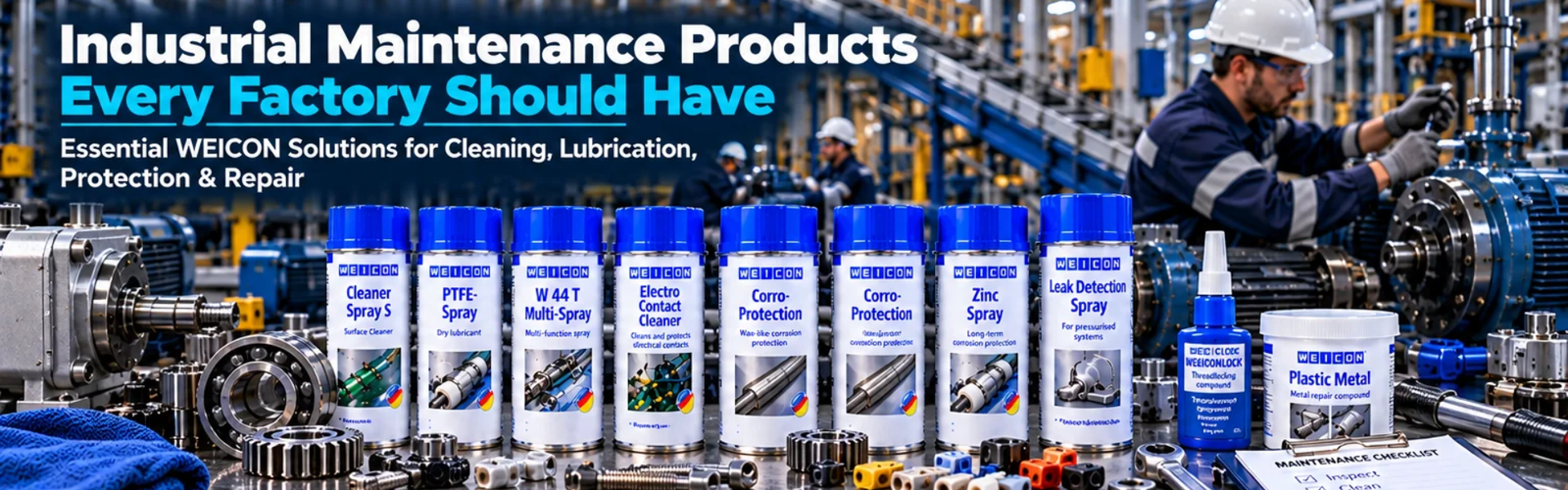
Industrial Maintenance Products Every Factory Should Have
Admin
|
21 Oct 2026
|
13 min read
|
41 views
Industrial Maintenance Products Every Factory Should Have
Introduction
Every factory depends on reliable equipment.
From production machinery and conveyor systems to electrical panels, motors, tools, automation equipment and mechanical assemblies, industrial equipment must operate consistently to maintain productivity and meet production requirements.
But even the best equipment requires regular maintenance.
Wear, friction, contamination, moisture, corrosion, vibration, temperature changes and continuous operation can gradually affect machinery and components. If these issues are not addressed, small maintenance problems can eventually develop into equipment failures and unexpected downtime.
This is why having the right industrial maintenance products readily available is an important part of an effective factory maintenance strategy.
A well-prepared maintenance team should not only have tools and spare parts. It should also have access to suitable products for cleaning, lubrication, corrosion protection, bonding, sealing, electrical maintenance, repair and general equipment servicing.
In this guide, we explore the essential industrial maintenance products every factory should consider keeping available, how they are used and what to consider when selecting them.
What Are Industrial Maintenance Products?
Industrial maintenance products are specialised products used to maintain, protect, repair, clean, lubricate, assemble or service industrial equipment and components.
They can be used across manufacturing facilities, engineering workshops, processing plants, warehouses, electrical installations, automation systems and other industrial environments.
Depending on the application, industrial maintenance products can include:
- Technical sprays
- Industrial cleaners
- Lubricants
- Corrosion protection products
- Penetrating oils
- Industrial adhesives
- Threadlockers
- Sealants
- Repair compounds
- Electrical contact cleaners
- Rust removers
- Maintenance chemicals
- Cable preparation products
- Specialist maintenance tools
The exact products required will vary depending on the factory's machinery, production processes, environmental conditions and maintenance requirements.
Why Every Factory Needs a Maintenance Product Strategy
Many factories have maintenance products stored throughout different departments.
However, simply having products available is not enough.
Maintenance teams need to know:
- Which product should be used?
- Where should it be used?
- How should it be applied?
- What materials is it compatible with?
- What conditions can it withstand?
- How frequently should it be used?
- What safety requirements apply?
A structured maintenance product strategy helps reduce confusion and makes it easier for technicians to respond to routine maintenance requirements.
It can also help reduce the risk of using an unsuitable product for a particular application.
1. Industrial Lubricants
Lubrication is one of the most important aspects of mechanical equipment maintenance.
Industrial machinery often contains moving components that experience friction during operation.
Lubrication can be required for applications involving:
- Bearings
- Chains
- Gears
- Hinges
- Bushes
- Shafts
- Mechanical assemblies
- Moving mechanisms
- Other friction points
The correct lubricant can help support smoother operation and reduce friction and wear.
What to consider when selecting an industrial lubricant
Factories should consider:
- Operating temperature
- Load
- Speed
- Material compatibility
- Environmental conditions
- Application method
- Manufacturer recommendations
Different applications require different lubrication solutions, so a general-purpose product should not automatically be used for every machine.
2. Technical Sprays
Technical sprays are among the most versatile products in an industrial maintenance environment.
Depending on the formulation, technical sprays can be used for:
- Cleaning
- Lubrication
- Corrosion protection
- Rust removal
- Penetration
- Moisture displacement
- Electrical contact maintenance
- Surface treatment
- General equipment maintenance
A factory may require several different technical sprays for different applications.
For example, a penetrating product may be useful for loosening components, while a contact cleaner may be intended for electrical applications.
The important consideration is selecting the correct product for the specific job.
3. Industrial Cleaners and Degreasers
Industrial equipment can accumulate:
- Oil
- Grease
- Dust
- Dirt
- Production residues
- Adhesive residues
- Contaminants
- Other deposits
If contaminants are allowed to accumulate, they can interfere with equipment operation and make maintenance inspections more difficult.
Industrial cleaners and degreasers can help maintenance teams clean equipment and prepare surfaces for further maintenance work.
They can be useful for applications such as:
- Machine cleaning
- Component cleaning
- Surface preparation
- Removal of grease
- Removal of oil
- Maintenance preparation
Before using a cleaner, always check its suitability for the surface and application.
4. Corrosion Protection Products
Corrosion can gradually damage metal components and equipment.
Factories operating in humid, wet, outdoor or chemically challenging environments may need to pay particular attention to corrosion protection.
Corrosion protection products can be used for suitable applications involving:
- Metal components
- Tools
- Machinery
- Fasteners
- Mechanical assemblies
- Electrical components where specifically approved
A corrosion protection program should ideally combine regular inspection, cleaning, appropriate storage and suitable protective products.
5. Rust Removal Products
Rust can make maintenance work more difficult.
Corroded fasteners, mechanical components and metal surfaces may require appropriate treatment before repair or servicing.
Rust removal products can assist with suitable applications where corrosion needs to be treated or removed.
However, the correct product should always be selected according to:
- Type of corrosion
- Material
- Surface condition
- Required finish
- Application method
6. Penetrating Oils
Maintenance technicians frequently encounter seized or difficult-to-remove components.
Fasteners and mechanical components can become difficult to move because of:
- Corrosion
- Rust
- Dirt
- Long periods without movement
- Environmental exposure
Penetrating products can be useful in appropriate applications to help technicians work with seized components.
Common applications may include:
- Bolts
- Nuts
- Screws
- Mechanical joints
- Hinges
- Fasteners
Using an appropriate penetrating product can help make maintenance tasks more manageable.
7. Industrial Adhesives
Industrial adhesives are increasingly important in manufacturing, assembly, repair and maintenance applications.
Depending on the product, industrial adhesives may be used for:
- Bonding
- Assembly
- Repair
- Component retention
- Sealing
- Gap filling
- Structural applications
- Vibration-resistant assembly
The major advantage of selecting a specialised industrial adhesive is that it can be designed for a particular material combination and operating environment.
Before choosing an adhesive, consider:
- Materials being bonded
- Required bond strength
- Temperature
- Chemical exposure
- Vibration
- Curing time
- Environmental conditions
8. Threadlockers
Mechanical fasteners can loosen because of vibration and operating conditions.
Threadlocking products are designed for appropriate threaded fastening applications.
They can be useful in machinery and equipment where maintaining fastener security is important.
Threadlockers can be selected according to factors such as:
- Required strength
- Thread size
- Service temperature
- Removal requirements
- Application conditions
The correct product should be selected based on the manufacturer's technical recommendations.
9. Industrial Sealants
Sealants can be useful for preventing unwanted leakage and creating suitable seals between components.
Depending on the application, industrial sealants may be used for:
- Flanges
- Threads
- Housings
- Mechanical assemblies
- Pipe connections
- Industrial equipment
When selecting a sealant, consider the:
- Material
- Temperature
- Pressure
- Chemical exposure
- Application environment
- Required curing characteristics
10. Electrical Contact Cleaners
Electrical and electronic components can be affected by contamination, moisture and oxidation.
Suitable electrical contact cleaning products can help maintenance technicians clean appropriate electrical contacts and connections.
Potential applications include:
- Electrical contacts
- Connectors
- Switches
- Relays
- Control equipment
- Electrical assemblies
Electrical maintenance should always be performed by suitably qualified personnel and according to appropriate safety procedures.
11. Cable Preparation Tools
Modern factories rely heavily on electrical systems, control systems and automation.
Cable preparation is therefore an important part of electrical installation and maintenance.
Specialist cable preparation tools can help technicians perform tasks such as:
- Cable stripping
- Cable cutting
- Jacket removal
- Preparation of cable ends
- Cable processing
Using appropriate professional tools can improve consistency and efficiency during electrical work.
For factories with significant electrical maintenance requirements, specialist cable preparation equipment can be an important addition to the maintenance toolkit.
12. Repair Compounds
Industrial equipment can occasionally require temporary or permanent repair solutions depending on the application.
Repair compounds may be used for suitable applications involving:
- Metal repair
- Surface restoration
- Filling
- Component repair
- Wear areas
- Maintenance applications
The correct repair compound depends heavily on the material and operating conditions.
Consider:
- Temperature
- Mechanical load
- Chemical exposure
- Surface material
- Cure requirements
- Required strength
13. Anti-Seize Products
Fasteners operating under high temperature, pressure or harsh environmental conditions may become difficult to remove.
Suitable anti-seize products can help in applications where future disassembly and protection of threaded components are important.
They can be considered for suitable:
- Bolts
- Nuts
- Threads
- Flanges
- Mechanical assemblies
Again, compatibility and operating conditions should always be checked before application.
14. Silicone and Specialised Lubricants
Certain industrial applications require specialised lubrication solutions rather than conventional lubricants.
Depending on the equipment and environment, specialised products may be needed for:
- Plastic components
- Rubber components
- Seals
- Electrical applications
- High-temperature environments
- Specific mechanical systems
Selecting the right formulation can be particularly important where material compatibility is critical.
15. Industrial Wipes and Cleaning Accessories
Maintenance is not only about chemicals and sprays.
Factories also require suitable cleaning accessories and consumables.
These can include:
- Industrial wipes
- Cleaning brushes
- Application accessories
- Surface preparation materials
- Maintenance consumables
Keeping suitable cleaning materials available can make routine maintenance tasks faster and more organised.
16. General Maintenance Tools
A maintenance department should also maintain a comprehensive selection of mechanical and specialist tools.
Depending on the factory, this may include:
- Hand tools
- Torque tools
- Cutting tools
- Cable tools
- Measuring equipment
- Assembly tools
- Specialist maintenance tools
Using the correct tool for the task can improve work quality and reduce the risk of damage caused by unsuitable equipment.
17. Corrosion-Resistant Maintenance Solutions
Factories exposed to harsh environments should consider corrosion protection at every stage of maintenance.
This can include:
Inspection → Cleaning → Treatment → Protection → Regular Monitoring
This approach is generally more effective than waiting until severe corrosion appears.
18. Surface Preparation Products
Surface preparation is often overlooked.
However, the condition of a surface can directly affect the performance of an adhesive, coating, sealant or repair compound.
Surface preparation may involve:
- Cleaning the surface
- Removing oil and grease
- Removing contaminants
- Removing loose corrosion
- Drying the surface
- Preparing the surface according to product instructions
Proper preparation can help improve the consistency of maintenance work.
19. Products for Preventive Maintenance
Preventive maintenance products should be selected according to the maintenance schedule of each machine.
A preventive maintenance kit may include suitable:
- Lubricants
- Cleaners
- Technical sprays
- Corrosion protection
- Adhesives
- Sealants
- Electrical maintenance products
- Tools
The exact contents should be based on the factory's equipment and maintenance history.
20. Emergency Maintenance Products
Factories should also consider maintaining a dedicated emergency maintenance stock.
This can help technicians respond quickly when unexpected problems occur.
An emergency maintenance kit may contain frequently used products such as:
- Penetrating spray
- Technical cleaner
- Lubricant
- Adhesive
- Sealant
- Threadlocker
- Corrosion protection product
- Electrical contact cleaner
- Repair compound
- Essential specialist tools
The purpose is not to replace proper repairs.
Instead, it is to ensure technicians have access to commonly required maintenance products when urgent situations arise.
How to Organise Industrial Maintenance Products
Having the right products is only one part of the process.
They should also be properly organised.
Consider creating separate storage areas for:
Mechanical Maintenance
- Lubricants
- Greases
- Penetrating products
- Threadlockers
- Anti-seize products
Electrical Maintenance
- Contact cleaners
- Electrical maintenance products
- Cable preparation tools
Surface Maintenance
- Cleaners
- Degreasers
- Rust removal products
- Corrosion protection
Assembly and Repair
- Adhesives
- Sealants
- Repair compounds
Clear labelling and proper storage can help technicians quickly identify the correct product.
How to Choose the Right Industrial Maintenance Product
Before purchasing any industrial maintenance product, ask the following questions.
1. What is the application?
Clearly define the maintenance task.
2. What material is involved?
Determine whether the component is made from:
- Steel
- Stainless steel
- Aluminium
- Plastic
- Rubber
- Composite
- Other materials
3. What environment will it operate in?
Consider:
- Temperature
- Humidity
- Water
- Chemicals
- Dust
- Vibration
- Outdoor exposure
4. What performance is required?
Determine the required:
- Strength
- Lubrication performance
- Corrosion protection
- Temperature resistance
- Chemical resistance
- Curing characteristics
5. Is the product compatible?
Always check technical documentation and manufacturer recommendations.
Why Product Quality Matters
Industrial maintenance products are used around valuable equipment.
A low-quality or unsuitable product can potentially create additional problems rather than solve the original issue.
For this reason, industrial businesses should consider:
- Product authenticity
- Technical specifications
- Manufacturer reputation
- Application suitability
- Storage requirements
- Technical support
- Availability
- Product documentation
Choosing products based on application and technical suitability is more important than simply choosing the cheapest available option.
Creating an Industrial Maintenance Inventory
Factories can create a maintenance inventory based on actual equipment requirements.
Start by listing:
Critical Machines
Identify machinery where failure would have a significant operational impact.
Common Maintenance Tasks
Document recurring maintenance activities.
Frequently Used Products
Identify products technicians use regularly.
Critical Products
Determine which products need to be immediately available.
Specialised Products
Identify products required only for particular equipment.
This approach helps prevent both shortages and unnecessary inventory.
Industrial Maintenance Products for Different Factory Areas
Different departments may require different maintenance solutions.
Production Areas
Common requirements can include:
- Lubricants
- Cleaners
- Technical sprays
- Fastener products
- Maintenance tools
Electrical Departments
Potential requirements include:
- Contact cleaners
- Cable tools
- Electrical maintenance products
- Cleaning products
Mechanical Workshops
Potential requirements include:
- Penetrating products
- Lubricants
- Threadlockers
- Anti-seize products
- Adhesives
- Sealants
- Repair compounds
Warehouse and Storage
Potential requirements include:
- Corrosion protection
- Cleaning products
- Maintenance consumables
- Equipment protection products
The Role of WEICON Products in Industrial Maintenance
WEICON develops specialised chemical products, technical sprays, adhesives, sealants, repair solutions and maintenance products used across industrial applications.
For factories looking to build a professional maintenance product inventory, WEICON products can provide solutions across several maintenance categories.
These can include products for:
- Cleaning
- Lubrication
- Corrosion protection
- Adhesive bonding
- Thread locking
- Sealing
- Repair
- Maintenance
- Surface treatment
The appropriate product should always be selected based on the specific application and technical requirements.
Why Australian Factories Need Reliable Product Supply
For Australian factories, product availability can be just as important as product quality.
A maintenance team may identify a problem, but if the required product is unavailable, the repair process can be delayed.
A reliable industrial supplier can help businesses with:
- Product sourcing
- Product availability
- Technical information
- Application guidance
- Industrial chemicals
- Technical sprays
- Adhesives
- Tools
- Maintenance solutions
Working with an experienced supplier can simplify procurement and help maintenance teams access the products they need.
Spleca Industrial Maintenance Solutions
Spleca supplies industrial automation products, electrical products, industrial chemicals, technical sprays, WEICON products, cable preparation tools and maintenance solutions across Australia.
Our range supports businesses involved in:
- Manufacturing
- Engineering
- Automation
- Electrical work
- Industrial maintenance
- Equipment servicing
- Production
- Industrial assembly
Whether your maintenance team needs a technical spray, industrial adhesive, corrosion protection product, cleaning solution, cable preparation tool or another specialised maintenance product, Spleca can help you find a suitable solution.
Our focus is on providing genuine industrial products backed by reliable service and technical support.
Industrial Maintenance Product Checklist
Before reviewing your factory maintenance inventory, use this checklist:
- Industrial lubricants
- Technical sprays
- Industrial cleaners
- Degreasers
- Corrosion protection products
- Rust removal products
- Penetrating products
- Industrial adhesives
- Threadlockers
- Industrial sealants
- Electrical contact cleaners
- Cable preparation tools
- Repair compounds
- Anti-seize products
- Specialist maintenance tools
- Industrial wipes
- Surface preparation products
- Emergency maintenance products
- Safety equipment
- Product technical documentation
Not every factory needs every product. The ideal maintenance inventory should be based on the actual machinery, processes and operating environment.
Frequently Asked Questions
What are the most important industrial maintenance products?
Commonly required products include lubricants, technical sprays, industrial cleaners, corrosion protection products, penetrating products, adhesives, sealants, electrical maintenance products and specialist tools.
What products should every factory keep in stock?
Every factory has different requirements. However, commonly used maintenance products such as suitable cleaners, lubricants, technical sprays and essential repair products should be considered based on equipment and maintenance history.
Why are technical sprays useful in factories?
Technical sprays can support applications including cleaning, lubrication, corrosion protection, penetration, electrical contact maintenance and general equipment servicing, depending on the product.
Are industrial adhesives useful for maintenance?
Yes. Industrial adhesives can be used for appropriate bonding, assembly, repair, sealing and component-retention applications.
How do I choose the right industrial lubricant?
Consider the equipment, operating temperature, load, speed, material compatibility, environmental conditions and manufacturer recommendations.
Why do factories need corrosion protection?
Corrosion can damage metal components and equipment over time. Suitable corrosion protection can help protect equipment when used as part of a broader maintenance strategy.
What should be included in an emergency maintenance kit?
Depending on the factory, an emergency kit may include commonly used technical sprays, lubricants, penetrating products, adhesives, sealants, electrical cleaners and repair products.
Where can I buy industrial maintenance products in Australia?
Industrial businesses should source maintenance products from reputable suppliers that can provide genuine products, technical information and application support.
Conclusion
A well-maintained factory is built on more than machines and spare parts.
It also depends on having access to the right industrial maintenance products at the right time.
From technical sprays and lubricants to industrial adhesives, sealants, cleaners, corrosion protection products, electrical maintenance solutions and specialist tools, these products support the day-to-day work required to keep industrial equipment operating reliably.
The best maintenance strategy is proactive.
By understanding equipment requirements, maintaining appropriate product inventories, training maintenance teams and selecting products according to their intended application, factories can create a more organised and effective maintenance environment.
For Australian manufacturers, engineering businesses and industrial maintenance teams, choosing a reliable supplier can make this process significantly easier.
Spleca supplies industrial maintenance products, WEICON solutions, technical sprays, industrial chemicals, electrical products, cable preparation tools and automation solutions across Australia.
Need help selecting the right maintenance product for your application? Contact Spleca today.
Explore Spleca
Browse Industrial Maintenance Products →
Explore WEICON Products →
View Technical Sprays →
Explore Industrial Adhesives →
Contact Spleca →
Explore Industrial Automation Products