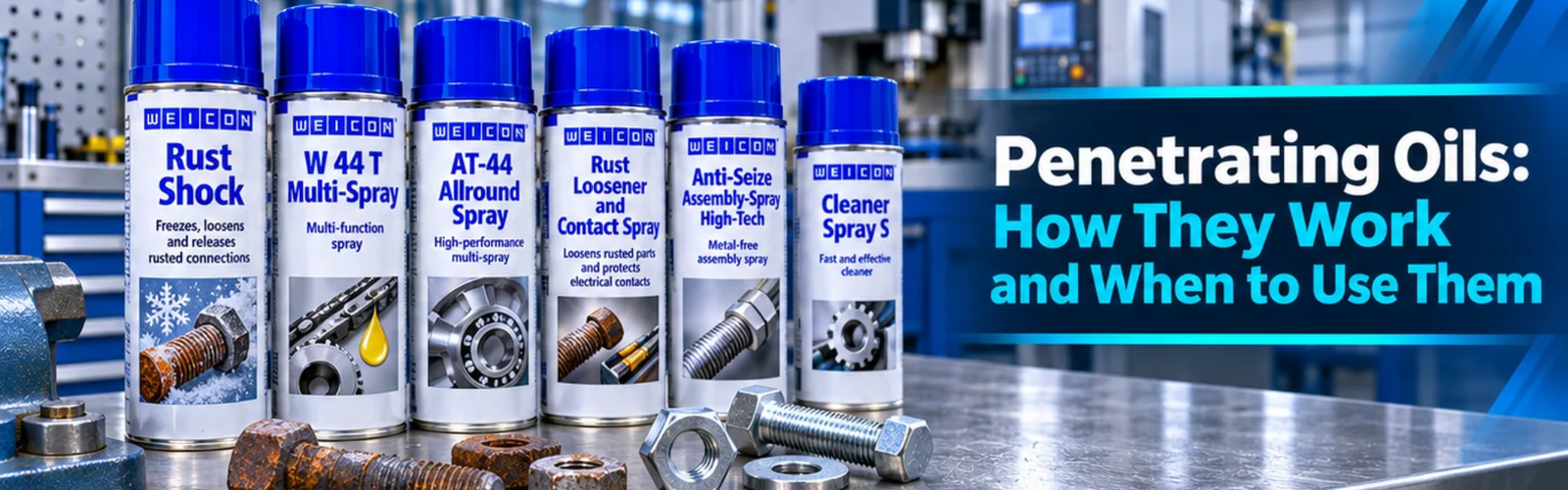
Penetrating Oils: How They Work and When to Use Them
Admin
|
05 Nov 2026
|
24 min read
|
13 views
Penetrating Oils: How They Work and When to Use Them
A seized bolt can turn a five-minute maintenance job into hours of frustration.
A rusted nut refuses to move. A threaded fitting has become locked in place. A hinge has seized. A pin will not come out. A machine component that should separate easily has effectively become one solid piece.
In these situations, applying more force is not always the best solution.
Excessive force can:
- Round bolt heads
- Break fasteners
- Damage threads
- Bend components
- Damage tools
- Increase maintenance time
- Create additional repair costs
- Increase the risk of injury
This is where penetrating oils, also called penetrating fluids or penetrants, become an important maintenance tool.
Penetrating oils are generally formulated as low-viscosity fluids designed to migrate into very small gaps between seized or corroded components. Their ability to enter tight clearances through capillary action, combined with solvents and lubricating components in many formulations, helps weaken corrosion bonds and reduce friction so that stuck parts can be released. WD-40
They are widely used in:
- Industrial maintenance
- Manufacturing
- Mining
- Automotive workshops
- Construction
- Marine environments
- Fabrication
- Plumbing
- Heavy equipment maintenance
- Machinery repair
- General mechanical maintenance
But penetrating oil is not simply "oil in a spray can."
Understanding how penetrating oils work, where they should be used, how long they should be allowed to work, and when another maintenance method is more appropriate can make a significant difference in maintenance efficiency.
1. What Is Penetrating Oil?
Penetrating oil is a specially formulated fluid designed to creep into narrow spaces between components that are stuck together, particularly where corrosion, rust, contamination or friction is preventing movement.
Unlike conventional lubricants, which are often designed to remain on a surface and provide long-term lubrication, penetrating oils are primarily designed to reach the interface between stuck components.
Typical targets include:
- Rusted nuts
- Seized bolts
- Corroded threads
- Stuck screws
- Seized pins
- Rusted hinges
- Corroded shafts
- Mechanical joints
- Pipe threads
- Clips and fasteners
- Locks
- Stuck machine components
Dedicated penetrants commonly use a low-viscosity formulation that can enter small gaps. Some formulations also contain solvents intended to attack or loosen corrosion and lubricating components that reduce friction after the joint begins moving. WD-40
2. What Is the Difference Between Penetrating Oil and Regular Lubricant?
This is one of the most important distinctions in industrial maintenance.
A general-purpose lubricant is usually designed to provide ongoing lubrication.
A penetrating oil is primarily designed to reach and release a stuck interface.
General-purpose lubricant
Its primary objective may be:
- Reduce friction
- Reduce wear
- Protect against corrosion
- Provide ongoing lubrication
- Maintain smooth movement
Penetrating oil
Its primary objective is often:
- Enter tight clearances
- Reach seized interfaces
- Loosen corrosion bonds
- Displace moisture where formulated to do so
- Reduce friction during disassembly
- Help free stuck components
A penetrant may leave behind some lubricating or protective film, but that does not automatically make it a replacement for the machine's specified long-term lubricant.
This distinction is particularly important in industrial maintenance.
Penetrating oil is primarily a problem-solving product for seized or difficult-to-release components—not necessarily the final lubricant for the machine.
3. Why Do Parts Become Seized?
Before understanding penetrating oil, it helps to understand why components become stuck.
There are several common causes.
3.1 Corrosion
Rust is one of the most common causes.
When steel or iron is exposed to moisture and oxygen, corrosion can occur.
Rust can build up around:
- Threads
- Bolt heads
- Nuts
- Pins
- Shafts
- Hinges
- Joints
The resulting corrosion products can effectively lock two components together.
4. Rust Can Lock Threads Together
Consider a conventional threaded connection.
Under normal conditions:
Bolt + Nut → Threads engage → Nut can rotate
After prolonged exposure to corrosion:
Bolt + Rust + Nut → Corrosion products occupy the thread interface → Movement becomes difficult
Rust can increase the resistance between the mating surfaces and physically interfere with normal thread movement.
A penetrating fluid attempts to get into this interface and weaken the conditions preventing movement.
Dedicated penetrating products are specifically designed for applications such as rusted nuts, bolts, threads and other seized components. WD-40
5. Over-Tightening Can Also Cause Problems
Not every seized fastener is caused by rust.
A bolt may become difficult to remove because it was:
- Over-tightened
- Installed incorrectly
- Subjected to excessive load
- Thermally cycled
- Damaged
- Deformed
- Cross-threaded
In these situations, penetrating oil may help reduce friction, but it cannot repair a mechanically damaged or distorted fastener.
This is an important limitation.
Penetrating oil can help with:
Corrosion + friction + contamination
But it cannot magically repair:
Broken threads + distorted metal + mechanically locked components
6. How Does Penetrating Oil Work?
The mechanism can be understood in several stages.
Stage 1 — Application
The penetrant is applied around the seized component.
Stage 2 — Wetting
The fluid spreads across the surface and attempts to reach the smallest available openings.
Stage 3 — Capillary penetration
The low-viscosity formulation moves into narrow gaps between surfaces.
Stage 4 — Corrosion interaction
Solvent components in many formulations can help weaken or dissolve deposits and corrosion products.
Stage 5 — Lubrication
Lubricating components reduce friction between mating surfaces.
Stage 6 — Mechanical release
Once resistance has been sufficiently reduced, the fastener or component can be worked loose.
This combination of penetration + corrosion loosening + lubrication is what makes penetrating oils useful for seized mechanical parts. WD-40
7. The Science of Capillary Action
One of the most important properties of a penetrating oil is its ability to move into extremely narrow spaces.
This is related to capillary action.
Imagine placing a very thin tube into a liquid.
Depending on the fluid's properties and the geometry of the space, the liquid can move through the narrow passage.
A similar principle helps a penetrating fluid migrate into:
- Thread gaps
- Seams
- Cracks
- Small clearances
- Interfaces between corroded surfaces
Dedicated penetrants are specifically formulated to take advantage of this behaviour. WD-40 describes its Specialist Penetrant as using capillary action to reach tight crevices, threads and seams. WD-40
8. Why Low Viscosity Matters
Viscosity describes how resistant a fluid is to flow.
A highly viscous fluid is relatively thick.
A low-viscosity fluid flows more easily.
For penetrating applications, low viscosity can be beneficial because the fluid needs to move into extremely narrow clearances.
Imagine trying to push:
Thick grease
into an extremely narrow thread interface.
Now compare that with:
A thin penetrating fluid
that can flow along the interface.
The second is much better suited to the job of reaching the stuck interface.
This is why penetrating oils are generally much thinner than many conventional greases.
9. Penetrating Oil Is More Than Just "Thin Oil"
Although low viscosity is important, penetration performance is not determined by viscosity alone.
A dedicated penetrant may combine:
- Low-viscosity base components
- Solvents
- Lubricating oils
- Corrosion inhibitors
- Wetting agents
- Other formulation-specific additives
Different manufacturers use different formulations.
The objective is to produce a fluid that can:
- Wet the surface
- Enter tight spaces
- Interact with corrosion
- Reduce friction
- Help release the component
For example, WD-40 explains that its Specialist Penetrant combines petroleum solvents, petroleum-based oil and propellant to support penetration, corrosion-bond disruption and lubrication. WD-40
10. What Happens to Rust?
Rust does not simply disappear because penetrating oil is applied.
Instead, the formulation can help weaken the bond between the corroded surfaces.
The solvent component can work its way into corrosion deposits and weaken their adhesion, while the lubricant component reduces friction at the interface.
The objective is therefore not necessarily:
"Dissolve all the rust."
It is:
Reduce the resistance created by corrosion enough for the components to separate.
This distinction is important when working on heavily corroded industrial equipment.
11. Why Penetrating Oil Needs Time
One of the biggest mistakes technicians make is:
Spray → immediately apply maximum force → bolt breaks.
Penetrating oil needs time to migrate into the joint.
The required dwell time depends on:
- Degree of corrosion
- Joint geometry
- Gap size
- Contamination
- Temperature
- Accessibility
- Fastener size
- Age of the corrosion
Light corrosion may release relatively quickly.
Severe corrosion may require:
- Multiple applications
- Longer soaking
- Mechanical agitation
- Repeated cycles
WD-40's application guidance recommends allowing the penetrant to soak before attempting to loosen the component and repeating the process where necessary. WD-40
12. When Should You Use Penetrating Oil?
Penetrating oils are particularly useful when a component is:
- Rusted
- Corroded
- Seized
- Frozen
- Difficult to turn
- Difficult to remove
- Exposed to moisture
- Contaminated
- Stuck after long periods of inactivity
Common applications include:
Rusted bolts
One of the most common applications.
Seized nuts
Penetrant can help reduce resistance at the threaded interface.
Rusted screws
Particularly useful where the screw head and threads remain intact.
Seized pins
Useful where corrosion has developed around the pin and bore.
Rusted hinges
Penetrant can migrate into the hinge joint and help restore movement.
Corroded pipe threads
Can assist during maintenance and replacement work.
Stuck mechanical components
Useful during equipment disassembly.
WD-40 specifically lists nuts, bolts, pipe threads, locks and other rusted or stuck components among penetrant applications. WD-40
13. Industrial Applications of Penetrating Oils
Penetrating oils are useful across many maintenance environments.
Manufacturing
Manufacturing facilities often have:
- Bolted machine frames
- Motors
- Pumps
- Conveyors
- Gearboxes
- Guards
- Fixtures
- Adjustment mechanisms
During maintenance shutdowns, corroded fasteners can significantly slow disassembly.
A penetrant can help maintenance teams release difficult fasteners before more aggressive techniques are considered.
14. Mining
Mining equipment operates in environments where corrosion, dust, moisture, vibration and heavy mechanical loading can create difficult maintenance conditions.
Potential applications include:
- Conveyor systems
- Crushers
- Screens
- Pumps
- Heavy mobile equipment
- Guards
- Access panels
- Mechanical linkages
- Maintenance fasteners
A seized fastener can create unnecessary downtime when equipment needs to be dismantled.
Penetrating oil can therefore become a useful part of a maintenance technician's toolbox.
However, the penetrant should be viewed as a disassembly aid, not automatically as the machine's long-term lubrication solution.
15. Heavy Equipment
Construction and earthmoving equipment can experience:
- Mud
- Water
- Dust
- Corrosion
- Heavy loading
- Long periods outdoors
Typical applications include:
- Excavators
- Loaders
- Cranes
- Forklifts
- Compactors
- Agricultural machinery
- Trailers
- Attachments
Fasteners that remain exposed to the environment can become difficult to remove over time.
Penetrating oil can assist with maintenance and component replacement.
16. Automotive and Fleet Maintenance
Automotive technicians frequently encounter:
- Rusted exhaust bolts
- Suspension fasteners
- Brake components
- Seized nuts
- Rusted hinges
- Stuck fittings
- Corroded clamps
Penetrating oil can reduce the need for excessive mechanical force and potentially reduce the risk of damaging otherwise reusable components.
WD-40 identifies automotive maintenance as one of the common environments in which penetrating oils are used. WD-40
17. Marine Applications
Marine equipment can be particularly vulnerable to corrosion because of:
- Moisture
- Salt exposure
- Humidity
- Atmospheric corrosion
- Long periods of inactivity
Penetrants can be useful when working with:
- Fasteners
- Hinges
- Mechanical linkages
- Fittings
- Locks
- Bolted connections
However, marine applications require careful consideration of corrosion protection after the component has been released.
Removing the seized component is only the first step.
The next step is preventing the problem from returning.
18. Fabrication and Engineering Workshops
Fabrication workshops frequently work with:
- Steel structures
- Machinery
- Fixtures
- Fasteners
- Cutting equipment
- Welding equipment
- Fabricated assemblies
During repairs or modifications, a stuck fastener can delay the entire job.
A penetrating oil can be used as part of a controlled disassembly process.
19. Plumbing and Pipe Maintenance
Penetrating oils can also be useful for certain mechanical connections involving:
- Nuts
- Bolts
- Pipe fittings
- Threaded connections
- Valves
- Brackets
- Clamps
However, compatibility must be considered carefully.
A penetrant should not automatically be used on every plumbing system or process line.
Always consider:
- Pipe material
- Seal material
- Process fluid
- Contamination requirements
- Manufacturer recommendations
20. Rusted Hinges
Hinges are a classic penetrating-oil application.
A hinge can become stiff because of:
- Rust
- Dirt
- Corrosion
- Lack of lubrication
- Environmental exposure
A penetrant can be applied around the pivot area.
Then:
- Allow it to penetrate.
- Move the hinge gently.
- Reapply if necessary.
- Remove excess contamination.
- Apply the appropriate long-term lubricant if required.
A dedicated penetrant can help restore movement, but if the hinge requires ongoing lubrication, a suitable long-term lubricant may be more appropriate after the initial release.
21. Seized Pins
Industrial machines often use pins for:
- Hinges
- Linkages
- Attachments
- Pivot points
- Mechanical joints
Corrosion can make pin removal extremely difficult.
Penetrating oil can be applied around the exposed interface and allowed to migrate into the clearance.
For heavily seized pins, additional methods may be required.
These can include:
- Mechanical extraction
- Controlled impact
- Pressing
- Heating where safe and permitted
- Cutting
- Component replacement
Penetrating oil should therefore be considered one part of the release strategy, not a guaranteed solution for every seized component.
22. Penetrating Oil vs Grease
| Feature | Penetrating Oil | Grease |
| Primary purpose | Release seized components | Long-term lubrication |
| Viscosity | Generally low | High/semi-solid |
| Penetration | Excellent for tight gaps | Limited |
| Rust release | Designed for this purpose | Not normally primary purpose |
| Long-term lubrication | Usually limited/application-specific | Commonly used |
| Bearing lubrication | Generally not a substitute | Common application |
| Seized fasteners | Excellent use case | Poor choice |
| High-load lubrication | Application dependent | Common |
| Automatic lubrication | Product/application specific | Specialised greases available |
| Disassembly work | Excellent | Usually not ideal |
The key distinction is:
Use a penetrant to get into the joint. Use the correct lubricant to keep the component working afterward.
23. Penetrating Oil vs General-Purpose Spray
Many people use the terms interchangeably, but they are not necessarily the same.
Some multi-purpose sprays can:
- Displace moisture
- Provide light lubrication
- Offer some corrosion protection
- Provide some penetrating action
Dedicated penetrating oils are specifically formulated around the requirement to release seized components.
WD-40 itself distinguishes its Specialist Penetrant from its original Multi-Use Product, explaining that the Specialist product is specifically formulated to penetrate rusted and seized parts. WD-40
Therefore, when dealing with a seriously seized industrial fastener, choosing a purpose-designed penetrant may be more appropriate than relying on a general-purpose spray.
24. How to Use Penetrating Oil Correctly
A good application process can make a significant difference.
Step 1 — Identify the problem
Determine whether the component is actually:
- Rusted
- Corroded
- Seized
- Dirty
- Mechanically damaged
- Cross-threaded
- Over-tightened
If the problem is mechanical deformation rather than corrosion, penetrant may have limited effectiveness.
25. Step 2 — Clean the Area
Remove loose:
- Dirt
- Mud
- Dust
- Rust scale
- Grease
- Debris
Cleaning helps expose the actual joint.
WD-40 recommends removing dirt and debris around the stuck component before applying its penetrant. WD-40
26. Step 3 — Apply the Penetrant
Apply the product directly to the area where the components meet.
For a bolt and nut:
Do not simply spray the top of the bolt head.
Try to get the penetrant around:
- Thread entry
- Nut interface
- Exposed threads
- Joint perimeter
The objective is to provide a pathway for the fluid to migrate into the threaded interface.
27. Step 4 — Allow Dwell Time
Do not immediately reach for the largest wrench available.
Allow the penetrant time to work.
For difficult components, repeated application may be required.
The appropriate dwell time depends on the product and severity of the corrosion.
Always follow the manufacturer's instructions.
28. Step 5 — Apply Controlled Mechanical Force
Once the penetrant has had time to work:
- Use the correct socket
- Use the correct wrench
- Ensure proper tool engagement
- Apply controlled force
- Avoid sudden uncontrolled loading
If the fastener begins to move:
Do not immediately force it through the entire thread.
Work it gradually.
29. Step 6 — Work the Fastener Back and Forth
For severely corroded threads, controlled movement can help.
Instead of:
Force → break
use:
Loosen slightly → tighten slightly → loosen → repeat
This can help work contamination and corrosion out of the thread interface.
Continue applying penetrant where appropriate.
30. Step 7 — Reapply If Necessary
Severe corrosion may require multiple applications.
If the component remains stuck:
- Reapply penetrant.
- Allow more dwell time.
- Mechanically agitate where appropriate.
- Try again.
- Escalate the method only when necessary.
Patience can be more effective than brute force.
31. Step 8 — Clean the Component After Release
Once the fastener is removed, inspect it.
Look for:
- Damaged threads
- Pitting
- Excessive corrosion
- Deformation
- Cracks
- Galling
- Material loss
Do not automatically reuse a fastener simply because it came out.
A component that has been severely corroded may need replacement.
32. Step 9 — Apply the Correct Long-Term Protection
Penetrating oil is often the beginning of the maintenance process rather than the end.
After removing the component, determine whether it needs:
- Anti-seize compound
- Assembly paste
- Grease
- Thread lubricant
- Corrosion inhibitor
- Protective coating
- Correct installation torque
The correct choice depends on the application.
For example, a threaded connection intended for future disassembly may require an appropriate anti-seize or assembly product.
33. When Penetrating Oil Is Not Enough
There are situations where a penetrant alone will not solve the problem.
Examples include:
Severely deformed bolt
The fastener may need extraction or replacement.
Stripped threads
Penetrant cannot restore damaged threads.
Broken fastener
Extraction may be required.
Heavy corrosion
The material may have deteriorated beyond safe reuse.
Mechanical interference
The parts may be physically distorted or misaligned.
Welded or mechanically locked component
Penetrant may have little effect.
In these cases, maintenance teams may need to escalate to:
- Mechanical extraction
- Impact tools
- Pullers
- Presses
- Controlled heating
- Cutting
- Drilling
- Specialist extraction equipment
Any use of heat around penetrant products must follow the product's safety instructions because many aerosol penetrants are flammable. WD-40's industrial documentation, for example, carries flammability and pressurised-container warnings. files.wd40.com
34. Why Excessive Force Can Be Dangerous
Imagine a rusted bolt that requires significant force to turn.
You attach a long breaker bar.
The force increases.
But the corrosion bond has not been sufficiently weakened.
Several things can happen:
- Bolt head rounds
- Socket slips
- Bolt snaps
- Tool breaks
- Component cracks
- Operator loses balance
A penetrant can help reduce the resistance before significant mechanical force is applied.
This is one reason penetrating oils can contribute to safer and more efficient maintenance practices when used correctly.
35. Penetrating Oil and Maintenance Downtime
A seized fastener may appear insignificant.
But in industrial maintenance, one stuck component can delay an entire job.
For example:
Machine shutdown
↓
Guard removal
↓
Rusted fastener discovered
↓
Fastener cannot be removed
↓
Additional tools required
↓
Extraction required
↓
Fastener damaged
↓
Replacement required
↓
Machine remains offline
A suitable penetrant used early in the maintenance process can help reduce unnecessary delays when corrosion is the primary cause of the seizure.
Dedicated penetrants are marketed specifically for reducing the effort and time involved in freeing stuck components. WD-40
36. Common Industrial Applications
| Application | Typical Problem | Penetrating Oil Use |
| Conveyor maintenance | Rusted fasteners | Release bolts |
| Mining equipment | Corroded joints | Assist disassembly |
| Pumps | Seized bolts | Free fasteners |
| Motors | Rusted mounting hardware | Assist removal |
| Gearboxes | Stuck covers/fasteners | Aid disassembly |
| Fabrication equipment | Corroded hardware | Release components |
| Heavy vehicles | Seized nuts | Assist removal |
| Agricultural machinery | Outdoor corrosion | Release fasteners |
| Marine equipment | Salt-related corrosion | Loosen hardware |
| Hinges | Rust/stiffness | Restore movement |
| Pipework | Seized threaded connections | Assist removal |
| Locks | Corrosion/seizing | Release mechanism |
37. Penetrating Oils in Preventive Maintenance
Penetrating oils are primarily associated with releasing seized components, but some products can also provide temporary corrosion protection.
Certain formulations leave a protective film after application.
However, maintenance teams should distinguish between:
Release treatment
Used when a component is already stuck.
Corrosion prevention
Used to prevent future corrosion.
Long-term lubrication
Used to maintain the component during operation.
These are three different maintenance objectives.
One product may provide multiple functions, but that does not mean it is automatically the best product for all three.
38. Choosing the Right Penetrating Oil
Not every penetrant is identical.
When selecting a penetrating oil, consider:
Penetration ability
How effectively does the formulation reach tight clearances?
Rust-release capability
Is it designed specifically for corrosion-bound fasteners?
Lubricating characteristics
Does it leave an appropriate lubricating film?
Corrosion protection
Does it provide temporary protection after application?
Evaporation characteristics
How quickly does the carrier evaporate?
Temperature limitations
What operating and application temperatures are permitted?
Material compatibility
Is it suitable for the materials involved?
Application method
Aerosol, bulk liquid, brush, extension tube, precision nozzle, etc.
Safety requirements
Check:
- SDS
- PPE requirements
- Ventilation
- Flammability
- Storage
- Disposal requirements
39. Penetrating Oil Selection Checklist
Before choosing a penetrant, ask:
☐ What component is seized?
☐ Is corrosion actually the cause?
☐ What materials are involved?
☐ How severe is the corrosion?
☐ How tight is the joint?
☐ Is water present?
☐ Is the application indoors or outdoors?
☐ Is the area well ventilated?
☐ Is the product compatible with surrounding materials?
☐ Is the product suitable for the required temperature?
☐ Is a low-odor formulation preferred or required?
☐ Will the component be exposed to heat after application?
☐ Does the component need long-term lubrication afterward?
☐ Is corrosion protection required after release?
☐ Does the manufacturer provide an SDS and technical information?
40. Common Mistakes When Using Penetrating Oil
Mistake 1: Using too little
The fluid needs to reach the joint.
A tiny amount sprayed onto the visible surface may not be enough.
Mistake 2: Not cleaning the area
Heavy dirt and rust scale can prevent the penetrant from reaching the interface effectively.
Mistake 3: Not allowing enough time
Penetrating oil is not necessarily an instant solution.
Severe corrosion can require repeated applications and longer dwell periods.
Mistake 4: Applying force immediately
Spraying a bolt and immediately using maximum force defeats much of the benefit.
Allow the penetrant to work first.
Mistake 5: Assuming every stuck part is rusted
A component can be stuck because of:
- Mechanical deformation
- Cross-threading
- Galling
- Over-tightening
- Damage
- Misalignment
Penetrant cannot fix every mechanical problem.
Mistake 6: Using penetrating oil as permanent grease
A penetrant may not be designed for the machine's long-term lubrication requirements.
Mistake 7: Ignoring material compatibility
Always check the product documentation when working around:
- Plastics
- Rubber
- Seals
- Coatings
- Special alloys
Mistake 8: Ignoring fire safety
Many aerosol penetrants contain flammable components.
Never use them near ignition sources unless the product is specifically designed and approved for that environment.
Always read the product label and SDS.
41. Penetrating Oil vs Heat
Heat is sometimes used to release seized fasteners because thermal expansion can change the relationship between components.
However, heat introduces additional risks.
These can include:
- Fire
- Damage to seals
- Damage to coatings
- Damage to nearby components
- Ignition of combustible materials
- Fumes
- Structural changes to components
Therefore, a penetrant may be a useful first-line method where appropriate before considering heat.
But heat should only be used when:
- The procedure permits it
- The surrounding environment is safe
- Combustible materials have been controlled
- The component can tolerate the temperature
- Appropriate PPE and fire controls are in place
42. Penetrating Oil vs Mechanical Force
Mechanical force remains an important maintenance technique.
The problem is using excessive force too early.
A better sequence is often:
Inspect
↓
Clean
↓
Apply penetrant
↓
Allow dwell time
↓
Apply controlled force
↓
Reapply if required
↓
Escalate extraction method if necessary
This approach can reduce unnecessary damage to reusable components.
43. Penetrating Oil and Corrosion Prevention
Once a seized component has been successfully removed, maintenance should consider why it seized in the first place.
Was it:
- Water exposure?
- Salt?
- Outdoor storage?
- Lack of protective coating?
- Poor sealing?
- Incorrect assembly?
- Long-term inactivity?
If the root cause is not addressed, the problem may return.
Possible preventive measures include:
- Corrosion-resistant materials
- Protective coatings
- Appropriate assembly compounds
- Anti-seize products
- Sealing
- Environmental protection
- Regular inspection
- Correct storage
- Periodic maintenance
Penetrating oil can help solve the immediate problem, but root-cause prevention is what reduces recurrence.
44. Penetrating Oil in Planned Shutdowns
Industrial shutdowns often involve disassembling equipment that has operated for months or years.
This can include:
- Pumps
- Motors
- Gearboxes
- Conveyors
- Valves
- Guards
- Flanges
- Inspection covers
- Structural components
Maintenance teams can identify corrosion-prone fasteners before the shutdown.
A planned approach can include:
- Identify critical fasteners.
- Inspect corrosion.
- Pre-treat where permitted.
- Allow adequate penetration time.
- Prepare correct tools.
- Begin controlled disassembly.
- Replace damaged fasteners.
- Apply appropriate assembly protection during reassembly.
This is much more efficient than discovering every seized fastener after the machine has already been taken offline.
45. Penetrating Oil as Part of an MRO Toolkit
MRO stands for:
Maintenance, Repair and Operations.
A well-prepared industrial maintenance toolkit may include:
- Penetrating oils
- Greases
- Gear oils
- Hydraulic fluids
- Anti-seize compounds
- Threadlockers
- Cleaners
- Degreasers
- Corrosion inhibitors
- Assembly pastes
- Sealants
- Lubrication equipment
Each product serves a different purpose.
Penetrating oil should therefore be considered one component of a broader industrial maintenance strategy.
46. A Practical Example: Removing a Rusted Conveyor Bolt
Imagine a conveyor guard that needs to be removed during scheduled maintenance.
Several bolts are heavily rusted.
Step 1
Inspect the fasteners.
Step 2
Remove loose dirt and rust scale.
Step 3
Apply penetrating oil around the threaded interface.
Step 4
Allow the penetrant to dwell.
Step 5
Apply controlled mechanical force.
Step 6
If the bolt begins moving, work it gradually.
Step 7
If it remains stuck, reapply the penetrant.
Step 8
If necessary, escalate to an approved extraction procedure.
Step 9
Inspect the removed bolt.
Step 10
Replace damaged fasteners.
Step 11
Apply the appropriate assembly/corrosion-protection product during reassembly.
This process is significantly better than immediately applying maximum torque and potentially snapping the fastener.
47. A Practical Example: Seized Pump Fastener
Consider an industrial pump that needs maintenance.
The pump mounting bolts have been exposed to:
- Water
- Dust
- Humidity
- Temperature variation
After years of operation, several bolts have seized.
The maintenance team should first determine:
- Whether the pump can be safely isolated
- Whether pressure has been removed
- Whether the surrounding area is safe
- Whether the penetrant is compatible with the application
Then:
Clean → Apply → Wait → Work → Reapply → Remove → Inspect
If the bolt cannot be safely removed with controlled mechanical force, the team should escalate using the plant's approved maintenance procedure.
48. How Penetrating Oil Supports Maintenance Efficiency
A good penetrant can help maintenance teams:
Reduce disassembly time
Stuck components can consume significant technician time.
Reduce excessive force
Less resistance can reduce the need for extreme leverage.
Reduce component damage
Controlled release can help preserve reusable fasteners and components.
Reduce downtime
Faster disassembly can contribute to shorter maintenance windows.
Improve technician productivity
Technicians spend less time fighting seized hardware.
These benefits are particularly valuable in industrial environments where equipment downtime can have a significant operational cost. Dedicated penetrants are specifically promoted for reducing effort and downtime associated with seized parts. WD-40
49. Penetrating Oil: Quick Reference Guide
| Situation | Use Penetrating Oil? |
| Rusted bolt | Yes |
| Seized nut | Yes |
| Rusted screw | Yes |
| Corroded hinge | Yes |
| Seized pin | Often |
| Stuck pipe thread | Often |
| Dirty component | Not as a cleaner alone |
| Long-term bearing lubrication | Usually no |
| Gearbox lubrication | No, unless specifically approved |
| Hydraulic system | No, unless specifically specified |
| Damaged threads | Limited benefit |
| Broken bolt | Usually requires extraction |
| Severely distorted component | Limited benefit |
| Corrosion prevention | Product-dependent |
| Temporary lubrication | Often, depending on formulation |
50. Frequently Asked Questions
What is penetrating oil used for?
Penetrating oil is primarily used to help release rusted, corroded, seized or stuck mechanical components such as bolts, nuts, screws, pins, hinges and threaded connections. WD-40
How does penetrating oil work?
It generally uses a low-viscosity formulation that can migrate into narrow gaps through capillary action. Depending on the formulation, solvents can help weaken corrosion while lubricating components reduce friction between mating surfaces. WD-40
How long should penetrating oil sit?
There is no single universal time.
It depends on:
- Product formulation
- Severity of corrosion
- Component geometry
- Temperature
- Degree of seizure
Follow the manufacturer's instructions and allow additional dwell time or repeated applications for heavily corroded components where appropriate. WD-40
Can penetrating oil remove rust?
Penetrating oil can help loosen corrosion-bound components, but it should not necessarily be viewed as a complete rust-removal treatment.
Its primary purpose is to help release seized interfaces.
Can penetrating oil be used as grease?
Not automatically.
A penetrant may provide temporary lubrication, but it should not replace the lubricant specified for a bearing, gearbox, chain or other machine component unless the manufacturer specifically approves that use.
Can penetrating oil prevent rust?
Some formulations provide corrosion protection after application.
However, the level and duration of protection vary by product. Always consult the manufacturer's technical information. WD-40 Specialist Penetrant, for example, states that its formulation leaves a lubricating layer and helps prevent corrosion from re-forming. WD-40
Can penetrating oil be used on bearings?
A penetrant should not automatically be used as the bearing's long-term lubricant.
Bearing lubrication requires consideration of:
- Bearing type
- Speed
- Temperature
- Load
- Grease/oil specification
- Compatibility
- Relubrication interval
Use the lubricant specified for the bearing application.
Is penetrating oil flammable?
Some aerosol penetrating oils are flammable.
Always check the product label and Safety Data Sheet before application, particularly around:
- Open flames
- Welding
- Hot surfaces
- Sparks
- Electrical equipment
- Confined spaces
Can penetrating oil be used on plastic or rubber?
It depends on the specific product and material.
Some products state compatibility with many common metals, plastics and rubbers when used as directed, but compatibility should always be verified for the specific application. WD-40
What should I do if penetrating oil does not work?
Do not simply keep increasing force.
Determine why the component is stuck.
If corrosion is severe, consider:
- Additional penetrant applications
- Mechanical agitation
- Controlled extraction
- Specialist tools
- Approved heating procedures
- Cutting or drilling
- Component replacement
Follow your site's maintenance and safety procedures.
51. Penetrating Oil Maintenance Checklist
Before using a penetrating oil:
☐ Identify why the component is stuck
☐ Isolate the equipment if required
☐ Remove pressure/energy sources where applicable
☐ Clean loose dirt and corrosion
☐ Check product compatibility
☐ Review the SDS
☐ Use appropriate PPE
☐ Ensure adequate ventilation
☐ Apply penetrant to the joint
☐ Allow adequate dwell time
☐ Use the correct tool
☐ Apply controlled force
☐ Reapply if necessary
☐ Avoid unnecessary excessive force
☐ Inspect the component after removal
☐ Replace damaged fasteners
☐ Apply appropriate long-term protection during reassembly
52. The Most Important Rule: Penetrate First, Force Second
When dealing with a seized mechanical component, the instinct is often:
"Get a bigger wrench."
A better maintenance mindset is:
"Understand why it is stuck, allow the penetrant to reach the joint, then apply controlled force."
Penetrating oils work because they are specifically designed to reach the interfaces that conventional lubricants may not easily reach.
The combination of:
Low viscosity
Surface wetting
Capillary penetration
Corrosion interaction
Friction reduction
can make a significant difference when dealing with seized mechanical components. WD-40
Conclusion
Penetrating oils are simple-looking products that perform an important role in industrial maintenance.
They are designed to help solve one of the most frustrating maintenance problems: components that should move but do not.
From rusted bolts and seized nuts to corroded hinges, pins, pipe threads and machine fasteners, penetrating oils can help maintenance technicians release components with less effort and potentially less damage.
But successful use depends on understanding what the product is—and what it is not.
A penetrating oil is generally:
- A release aid
- A corrosion-interface treatment
- A low-viscosity penetrating fluid
- A temporary friction-reduction solution
- A useful MRO maintenance product
It is not automatically:
- Bearing grease
- Gear oil
- Hydraulic oil
- A permanent machine lubricant
- A replacement for anti-seize
- A solution for mechanically damaged components
The most effective maintenance approach is therefore:
Identify the problem → Clean the joint → Apply the correct penetrant → Allow it to work → Apply controlled force → Reapply if necessary → Inspect the component → Apply the correct long-term protection.
When used correctly, penetrating oils can help maintenance teams reduce unnecessary force, protect components, shorten disassembly time and keep industrial maintenance work moving.
Need the Right Industrial Maintenance Solution?
Choosing the right penetrating oil depends on the application, corrosion level, component materials, operating environment and required maintenance procedure.
LECA provides industrial maintenance and engineering solutions designed to support demanding industrial environments.
Whether you need solutions for seized fasteners, corrosion protection, industrial lubrication, maintenance, repair or machinery servicing, selecting the correct product for the actual application is essential.
Technical References
- WD-40 — How Penetrating Oil Works and application guidance. WD-40
- WD-40 Specialist — Penetrant product information and capillary-action explanation. WD-40
- WD-40 India — When to use a penetrant and product FAQ. WD40 India
- Practical Sailor — Comparative discussion of penetrating fluids and their functions. practical-sailor.com
- Global Aerosols — Penetrating-oil formulation and capillary-action overview.
Talk to a LECA Technical Expert
Explore Industrial Automation Products