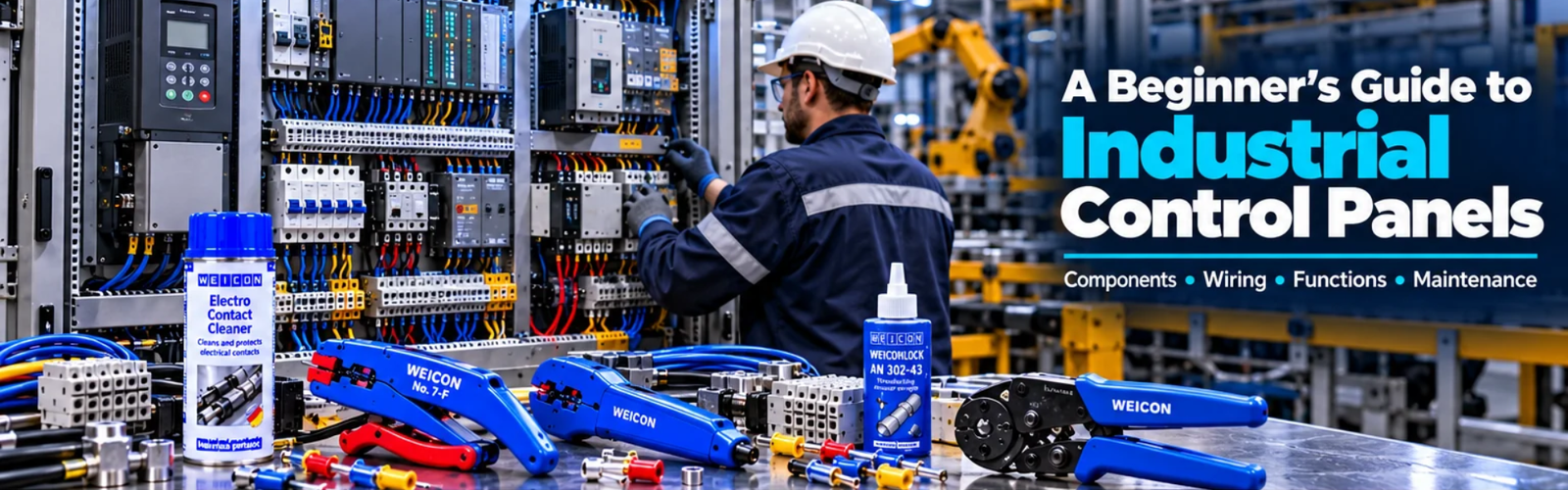
A Beginner’s Guide to Industrial Control Panels
Admin
|
26 Oct 2026
|
15 min read
|
53 views
A Beginner's Guide to Industrial Control Panels
Industrial control panels are at the heart of many modern manufacturing, processing, mining, and automation systems. They bring together electrical power, control devices, protection equipment, communication components, and automation hardware in one organised enclosure.
For someone new to industrial automation, a control panel can initially look complicated—rows of circuit breakers, contactors, relays, PLCs, terminals, cables, drives, displays, and other components all working together.
But once you understand the purpose of each component and how they interact, the overall system becomes much easier to understand.
This beginner's guide explains what an industrial control panel is, how it works, the major components inside it, different types of panels, how PLCs and VFDs integrate with panels, important design considerations, common mistakes, maintenance requirements, and how to select the right control panel for an industrial application.
What Is an Industrial Control Panel?
An industrial control panel is an electrical enclosure that contains the components required to control, monitor, protect, and distribute electrical power to industrial equipment and machinery.
Depending on the application, a control panel may contain:
- Circuit breakers
- Fuses
- Contactors
- Overload relays
- Control relays
- PLCs
- HMIs
- Variable Frequency Drives (VFDs)
- Servo drives
- Power supplies
- Transformers
- Terminal blocks
- Communication modules
- Safety relays
- Sensors and signal interfaces
- Network switches
- Meters and monitoring devices
The panel essentially acts as the control centre of an industrial machine or process.
A simple system might use a panel to start and stop a motor.
A more advanced system could use a control panel to manage an entire automated production line involving dozens of motors, sensors, valves, conveyors, robots, safety systems, and communication networks.
Why Are Industrial Control Panels Important?
Industrial equipment requires more than simply connecting a motor or machine to an electrical supply.
A properly designed control system must provide:
1. Control
The panel determines when and how equipment operates.
For example:
- Start motor
- Stop motor
- Change motor speed
- Open valve
- Close valve
- Start conveyor
- Stop conveyor
- Control temperature
- Monitor pressure
2. Protection
Electrical equipment needs protection against abnormal conditions such as:
- Short circuits
- Overloads
- Voltage problems
- Excessive current
- Phase loss
- Equipment faults
3. Automation
Control panels allow machines to operate automatically based on programmed logic and sensor inputs.
4. Monitoring
Operators can monitor:
- Machine status
- Motor speed
- Temperature
- Pressure
- Production counts
- Fault conditions
- Energy consumption
5. Safety
Modern industrial panels can integrate safety devices such as:
- Emergency stops
- Safety relays
- Door interlocks
- Light curtains
- Safety PLCs
- Machine guarding systems
How Does an Industrial Control Panel Work?
At a basic level, an industrial control system follows a simple sequence:
Power → Protection → Control → Field Devices → Feedback
For example, consider an automated conveyor.
A typical sequence could be:
- Electrical power enters the control panel.
- A circuit breaker provides protection.
- The PLC receives a start command.
- The PLC checks safety conditions.
- The PLC sends a command to a VFD.
- The VFD starts the conveyor motor.
- Sensors monitor the conveyor.
- Sensor information returns to the PLC.
- The PLC adjusts or stops the system when required.
- The HMI displays the machine status to the operator.
This creates a continuous control loop between the operator, controller, machine and sensors.
Main Components Inside an Industrial Control Panel
Understanding the individual components is the easiest way for a beginner to understand a control panel.
1. Main Circuit Breaker
The main circuit breaker controls incoming electrical power to the panel.
It allows operators or maintenance personnel to isolate the panel from the incoming supply.
It also provides protection against certain electrical faults.
Depending on the installation, different types of protective devices may be used.
2. Fuses
Fuses protect electrical circuits by interrupting the circuit when excessive current flows.
They are commonly used to protect:
- Control circuits
- Power supplies
- Transformers
- Electronic equipment
- Individual branch circuits
The correct fuse rating must be selected according to the application.
3. Contactors
A contactor is an electrically controlled switching device commonly used for switching motors and other high-power loads.
For example:
PLC → Contactor → Motor
When the control system activates the contactor, its power contacts close and supply power to the motor.
Contactors are particularly common in traditional motor-control systems.
4. Overload Relay
Motors need protection against excessive current caused by conditions such as mechanical overload.
An overload relay monitors the motor current and can disconnect the motor control circuit when an overload condition occurs.
A simplified motor-control arrangement may therefore look like:
Circuit Breaker → Contactor → Overload Relay → Motor
5. PLC — Programmable Logic Controller
The PLC is one of the most important components in modern industrial automation.
A PLC is a programmable industrial controller that receives inputs, processes programmed logic, and produces outputs.
For example:
Inputs
- Start button
- Stop button
- Proximity sensor
- Temperature sensor
- Pressure switch
- Level sensor
PLC
The PLC processes the information according to its program.
Outputs
- Motor starter
- Solenoid valve
- Contactor
- Alarm
- Indicator
- VFD command
A simple example:
If the tank level is low, start the pump.
If the tank reaches the required level, stop the pump.
The PLC continuously monitors the relevant inputs and executes this logic.
6. HMI — Human Machine Interface
An HMI allows operators to interact with the automation system.
Instead of relying only on physical buttons and indicator lamps, an HMI can provide a graphical interface showing:
- Motor status
- Machine status
- Alarms
- Temperature
- Pressure
- Production information
- Speed
- Setpoints
- Fault messages
Operators can also use the HMI to control equipment, depending on the system design and permissions.
For example, an HMI screen might show:
Conveyor 1 — RUNNING
Motor Speed — 45 Hz
Temperature — 68°C
Production Count — 1,245
This makes the system easier to operate and monitor.
7. Variable Frequency Drive (VFD)
A Variable Frequency Drive, commonly called a VFD, controls the speed and operation of an AC motor by varying the electrical frequency and voltage supplied to the motor.
VFDs are widely used in applications such as:
- Conveyors
- Pumps
- Fans
- Compressors
- Mixers
- Crushers
- Material-handling systems
For example, instead of operating a conveyor motor at a fixed speed, a VFD can allow the control system to adjust its speed according to production requirements.
A typical architecture could be:
PLC → VFD → Motor
The PLC provides the command, while the VFD controls the motor.
8. Servo Drives
Servo systems are used where precise motion control is required.
They are commonly found in:
- CNC machines
- Robotics
- Packaging machines
- Pick-and-place systems
- Automated production machinery
- Precision positioning equipment
A servo system may control:
- Position
- Speed
- Acceleration
- Torque
Compared with a basic motor-control system, servo systems provide much greater control over machine movement.
9. Power Supply
Many industrial control components do not operate directly from the incoming mains supply.
A control panel may therefore contain a power supply that converts the incoming voltage to the voltage required by control components.
A common example is a 24 V DC control circuit.
This can supply devices such as:
- PLCs
- Sensors
- Relays
- HMIs
- Communication equipment
10. Terminal Blocks
Terminal blocks provide organised connection points between internal panel wiring and external field wiring.
They help connect devices such as:
- Sensors
- Motors
- Valves
- Switches
- Actuators
- Control signals
Proper terminal identification makes troubleshooting and maintenance much easier.
11. Relays
Relays allow one electrical circuit to control another circuit.
They can be used for:
- Signal isolation
- Switching
- Interlocking
- Control logic
- Alarm circuits
- Interface applications
Although many control functions are now handled digitally by PLCs, relays remain important in industrial control systems.
12. Safety Components
Safety is one of the most important considerations in industrial automation.
Depending on the machine, the panel may include:
- Emergency-stop circuits
- Safety relays
- Safety PLCs
- Door switches
- Guard interlocks
- Light curtains
- Safety contactors
These systems are designed to help bring machinery to a safe state when a dangerous condition is detected.
13. Communication Equipment
Modern industrial control panels are increasingly connected.
A panel may contain:
- Ethernet switches
- Industrial network modules
- PLC communication cards
- Remote I/O
- Gateway devices
- Industrial communication interfaces
These components allow controllers, drives, HMIs, sensors and other devices to exchange information.
Modern industrial systems may use communication technologies such as:
- Ethernet-based industrial networks
- Modbus
- PROFINET
- EtherNet/IP
- CAN-based networks
- Other application-specific protocols
The exact communication technology depends on the equipment and system architecture.
What Is the Difference Between a Power Panel and a Control Panel?
This is an important distinction for beginners.
Power Panel
A power panel primarily focuses on electrical power distribution and protection.
It may contain:
- Circuit breakers
- Switchgear
- Fuses
- Distribution equipment
- Protection devices
Control Panel
A control panel focuses on controlling and monitoring machinery or processes.
It may contain:
- PLC
- HMI
- Relays
- Contactors
- VFDs
- Power supplies
- Communication modules
- Terminal blocks
In many industrial installations, power and control functions can be integrated into one overall electrical system.
Common Types of Industrial Control Panels
Control panels vary significantly depending on the application.
1. Motor Control Panel
Designed primarily to control electric motors.
Applications include:
- Pumps
- Fans
- Conveyors
- Compressors
- Industrial machinery
2. PLC Control Panel
Built around a programmable logic controller.
These panels are commonly used for automated machinery and processes.
3. VFD Control Panel
Designed around variable frequency drives for applications requiring motor speed control.
Typical applications include:
- Pumps
- Fans
- Conveyors
- HVAC
- Material handling
4. MCC — Motor Control Centre
An MCC is designed to house and control multiple motor circuits.
MCCs are common in larger industrial facilities where numerous motors need to be controlled from a central location.
5. Automation Control Panel
A more comprehensive panel that may integrate:
- PLC
- HMI
- VFDs
- Servo drives
- Sensors
- Safety systems
- Communication networks
These are common in automated manufacturing and processing systems.
Industrial Control Panel Example
Consider an automated water pumping system.
The system could include:
Level Sensor → PLC → VFD → Pump
The process could work as follows:
- The level sensor measures the tank level.
- The signal reaches the PLC.
- The PLC determines whether pumping is required.
- The PLC sends a command to the VFD.
- The VFD controls the pump motor.
- The tank level changes.
- The sensor provides updated information.
- The PLC adjusts the system accordingly.
The HMI can display the entire process to the operator.
This is a simple example of how multiple components inside a control panel work together.
Control Panel Wiring
Wiring is a critical part of control panel construction.
A panel may contain several different wiring categories:
Power Wiring
Used for higher-power electrical circuits such as motors and drives.
Control Wiring
Used for commands and control signals.
Signal Wiring
Used to transmit information from sensors and instruments.
Communication Wiring
Used to connect networked industrial devices.
Good wiring practices should include:
- Clear identification
- Proper cable routing
- Appropriate cable sizing
- Proper termination
- Separation of power and sensitive signal wiring
- Correct earthing
- Secure connections
- Proper labelling
A well-organised panel is significantly easier to troubleshoot.
Why Panel Layout Matters
Control panel design is not simply about fitting components into an enclosure.
Component placement can affect:
- Cooling
- Accessibility
- Maintenance
- Electrical noise
- Wiring length
- Safety
- Troubleshooting
- Future expansion
For example, heat-generating devices such as VFDs may require appropriate spacing and ventilation.
Sensitive electronic equipment may also need to be positioned carefully to minimise electrical interference.
Enclosure Selection
The enclosure protects the internal components from the surrounding environment.
Selection depends on the installation environment.
Consider factors such as:
- Dust
- Water
- Humidity
- Temperature
- Chemicals
- Corrosive environments
- Mechanical impact
- Outdoor exposure
Industrial environments can be particularly demanding.
For example, mining and processing environments may expose equipment to significant dust, vibration and harsh operating conditions.
The enclosure and protection level should therefore be selected appropriately for the application.
Cooling and Ventilation
Heat can significantly affect electrical and electronic equipment.
Components such as:
- VFDs
- Power supplies
- Transformers
- Drives
- Contactors
can generate heat during operation.
Depending on the application, a control panel may require:
- Ventilation
- Cooling fans
- Filters
- Air conditioning
- Heat exchangers
The thermal requirements should be considered during the design stage rather than after the panel has been installed.
Industrial Control Panels and Automation
Control panels are becoming increasingly sophisticated as industrial automation develops.
A modern system can combine:
Sensors + PLC + HMI + VFD + Servo + Network + Data
This allows industrial facilities to move beyond simple start/stop control toward intelligent monitoring and automation.
For example, a modern system can monitor:
- Motor current
- Temperature
- Vibration
- Production rates
- Energy consumption
- Machine faults
- Equipment operating hours
This information can then be used for maintenance and operational decisions.
Control Panels and Industry 4.0
Industry 4.0 is pushing industrial control systems toward greater connectivity and data visibility.
Instead of a control panel operating as an isolated system, it can become part of a larger digital infrastructure.
A simplified architecture could be:
Machine → PLC → Industrial Network → SCADA → Database → Analytics
This can enable businesses to understand machine performance and production data in greater detail.
Connected control systems can support applications such as:
- Remote monitoring
- Production analytics
- Predictive maintenance
- Energy monitoring
- Equipment performance tracking
- Automated reporting
Common Control Panel Problems
Even well-designed control panels can experience problems.
Common issues include:
Loose Connections
Loose terminals can create intermittent faults and overheating.
Incorrect Wiring
Incorrectly terminated wires can cause equipment malfunction or unexpected operation.
Poor Heat Management
Excessive temperatures can reduce component reliability.
Overloaded Components
Components must be appropriately rated for their intended application.
Poor Labelling
Unclear wiring makes troubleshooting slower and more difficult.
Electrical Noise
Poor segregation of power and signal wiring can affect sensitive equipment.
Inadequate Maintenance
Dust, corrosion, loose connections and component degradation can eventually lead to failures.
Control Panel Maintenance Checklist
Regular inspection can help identify problems before they become major failures.
A maintenance program may include checking:
- Panel cleanliness
- Cable connections
- Terminal tightness
- Signs of overheating
- Component condition
- Cooling fans
- Filters
- VFD status
- PLC diagnostics
- HMI alarms
- Circuit breakers
- Contactors
- Relays
- Earthing
- Communication connections
- Safety devices
The exact maintenance procedure should always follow the equipment manufacturer's requirements and the site's electrical safety procedures.
How to Choose the Right Control Panel
Before specifying or purchasing a control panel, understand the application first.
Consider:
1. What equipment needs to be controlled?
For example:
- Motors
- Pumps
- Conveyors
- Valves
- Robots
- CNC equipment
2. How many inputs and outputs are required?
This determines the required PLC and I/O architecture.
3. Is speed control required?
If yes, a VFD or another appropriate drive system may be required.
4. Is precise positioning required?
Servo or motion-control technology may be more appropriate.
5. What environmental conditions exist?
Consider:
- Indoor/outdoor installation
- Dust
- Moisture
- Heat
- Chemicals
- Vibration
6. What communication is required?
Determine how the PLC, HMI, drives and other equipment will communicate.
7. What safety functions are required?
Safety requirements should be considered from the beginning of the design.
8. Is future expansion expected?
Allowing space and capacity for future additions can prevent expensive redesigns later.
Industrial Control Panels for Mining
Mining operations often require robust control systems capable of operating in demanding environments.
Control panels can be used for:
- Conveyors
- Crushing systems
- Pumping systems
- Material handling
- Ventilation
- Processing equipment
- Water management
- Automated machinery
Because mining environments can involve dust, vibration, moisture and continuous operation, equipment selection and panel design become particularly important.
For businesses operating in Western Australia, control systems may also need to support the practical requirements of remote sites, maintenance accessibility and harsh industrial conditions.
Industrial Control Panels for Manufacturing
Manufacturing facilities rely heavily on control panels to coordinate automated equipment.
Applications can include:
- Assembly lines
- Packaging machines
- CNC machinery
- Conveyor systems
- Robotics
- Material handling
- Production monitoring
A single manufacturing line may have multiple control panels communicating with each other through industrial networks.
Benefits of a Well-Designed Control Panel
A properly designed control panel can provide:
Better Equipment Control
Operators gain precise control over industrial machinery.
Improved Safety
Protection and safety systems help reduce operational risks.
Easier Troubleshooting
Clear wiring, labelling and diagnostics make faults easier to identify.
Better Automation
PLCs and drives reduce manual intervention.
Improved Monitoring
HMIs and communication systems provide better visibility.
Scalability
A well-planned system can be easier to expand.
Improved Reliability
Correct component selection, thermal management and wiring practices can contribute to dependable operation.
Common Mistakes When Designing Control Panels
Some mistakes can create unnecessary problems later.
Mistake 1: Designing Without Understanding the Process
The panel should be designed around the machine and process—not simply around the components.
Mistake 2: Ignoring Heat
Thermal calculations and cooling requirements should be considered.
Mistake 3: Poor Component Placement
Crowded layouts can make maintenance difficult.
Mistake 4: Poor Labelling
Every important wire, terminal and component should be clearly identified.
Mistake 5: No Future Expansion
Leaving no room for future modifications can increase costs later.
Mistake 6: Mixing Sensitive Signals With Power Wiring
Poor cable segregation can create signal interference.
Mistake 7: Treating Safety as an Afterthought
Safety should be integrated into the control architecture from the beginning.
Industrial Control Panel Design Checklist
Before finalising a control panel, consider:
| Requirement | Check |
| Incoming power requirements | ✓ |
| Short-circuit protection | ✓ |
| Motor protection | ✓ |
| PLC requirements | ✓ |
| I/O requirements | ✓ |
| HMI requirements | ✓ |
| VFD/drive requirements | ✓ |
| Safety requirements | ✓ |
| Communication requirements | ✓ |
| Enclosure requirements | ✓ |
| Cooling requirements | ✓ |
| Cable routing | ✓ |
| Terminal identification | ✓ |
| Earthing | ✓ |
| Future expansion | ✓ |
| Maintenance accessibility | ✓ |
A good control panel design considers the entire system rather than individual components in isolation.
Frequently Asked Questions
What is an industrial control panel?
An industrial control panel is an enclosure containing electrical, automation, protection and control components used to operate and monitor industrial machinery or processes.
What is usually inside a control panel?
Depending on the application, a panel may contain circuit breakers, contactors, relays, PLCs, HMIs, VFDs, power supplies, terminal blocks, communication equipment and safety components.
What does a PLC do in a control panel?
A PLC receives information from inputs such as sensors and switches, processes programmed logic, and controls outputs such as motors, valves, relays and other equipment.
What is the difference between a PLC and a VFD?
A PLC is primarily a controller that makes decisions based on programmed logic. A VFD is primarily used to control the speed and operation of an AC motor.
They often work together.
Why is an HMI used?
An HMI provides an interface through which operators can monitor and control a machine or process.
Are control panels only used in manufacturing?
No. They are used across many industries, including:
- Mining
- Manufacturing
- Water treatment
- Food processing
- Energy
- Infrastructure
- Material handling
- Building services
- Industrial automation
How often should an industrial control panel be maintained?
Maintenance frequency depends on the equipment, operating environment, manufacturer recommendations and site requirements. Harsh environments may require more frequent inspection.
Can an existing control panel be upgraded?
Yes. Depending on its condition and architecture, an existing panel may be upgraded with modern PLCs, HMIs, drives, communication systems, monitoring equipment or safety components.
Conclusion
An industrial control panel is much more than a box containing electrical components.
It is the central control and coordination point for industrial equipment.
From basic motor control using contactors and overload protection to advanced automation using PLCs, HMIs, VFDs, servo drives, sensors and industrial networks, control panels form the foundation of countless automated systems.
Understanding the role of each component is the first step toward understanding industrial automation as a whole.
For businesses looking to build, upgrade or troubleshoot an industrial automation system, the right control-panel architecture can make a significant difference in reliability, safety, maintainability, scalability and overall machine performance.
Looking for Industrial Automation & Control Solutions?
At LECA, we help businesses source and implement industrial automation and control solutions suited to their operational requirements.
From PLCs, HMIs, VFDs and automation components to industrial electrical and control solutions, the right equipment starts with understanding the application.
Need help selecting the right industrial automation components or control solution? Contact LECA today.
Explore Industrial Automation Products