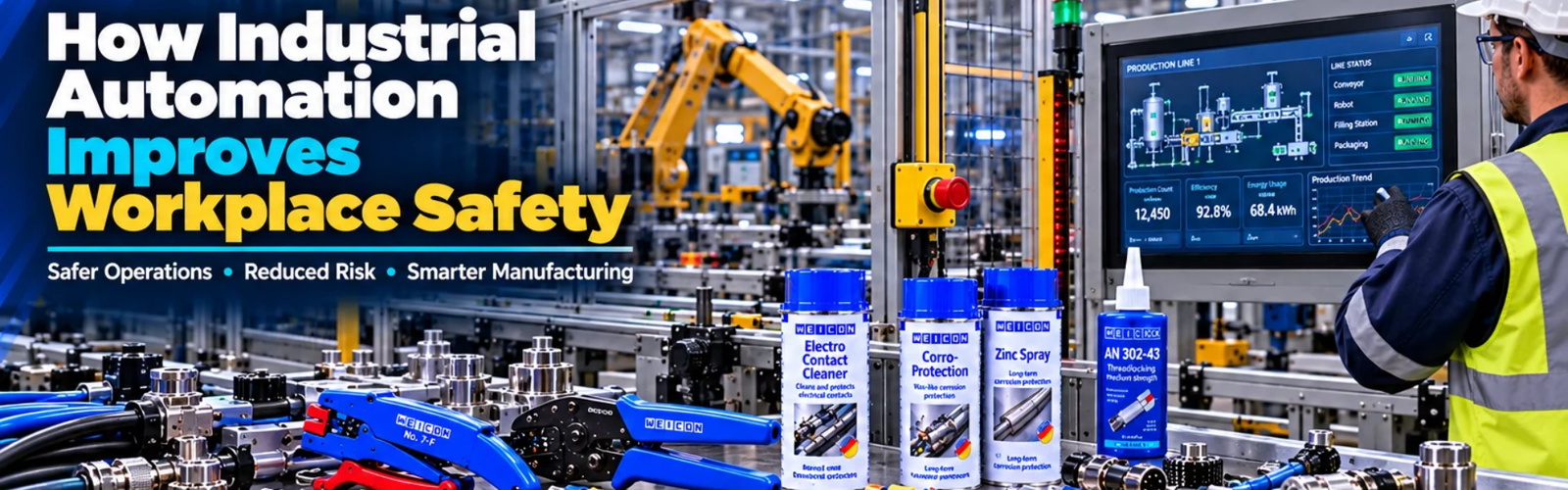
How Industrial Automation Improves Workplace Safety
Admin
|
29 Oct 2026
|
12 min read
|
53 views
How Industrial Automation Improves Workplace Safety
Workplace safety is one of the most important priorities in modern industrial environments.
Manufacturing facilities, mining operations, processing plants and other industrial workplaces often involve heavy machinery, moving equipment, high temperatures, electrical systems, chemicals and repetitive processes. Without appropriate controls, these environments can expose workers to significant risks.
Industrial automation can help reduce many of these risks by allowing machines to perform hazardous, repetitive or physically demanding tasks while providing operators with better monitoring, control and safety mechanisms.
Automation does not eliminate the need for people or safety procedures. Instead, when properly designed and implemented, it can become an important part of a broader workplace safety strategy.
From safety sensors and emergency-stop systems to automated material handling, robotics, PLCs and machine monitoring, modern automation technologies can help create safer and more controlled industrial environments.
What Is Industrial Automation?
Industrial automation involves using control systems, machines and technology to perform industrial processes with reduced manual intervention.
An automated system can include:
- PLCs
- HMIs
- SCADA systems
- Sensors
- Safety controllers
- VFDs
- Servo systems
- Robots
- Automated conveyors
- Vision systems
- Actuators
- Industrial communication networks
These technologies work together to monitor conditions, make control decisions and operate equipment according to programmed requirements.
Safety can be incorporated into these systems so that dangerous conditions trigger appropriate responses.
Why Is Automation Important for Workplace Safety?
Industrial environments can expose workers to hazards such as:
- Moving machinery
- Heavy loads
- Electrical equipment
- High temperatures
- Pressurised systems
- Hazardous substances
- Repetitive tasks
- Dust
- Noise
- Vehicle movement
- Working in difficult-to-access areas
Automation can reduce exposure to some of these hazards by allowing machines to perform certain tasks remotely or automatically.
For example, an automated conveyor system can transport materials without requiring workers to manually move every item.
Similarly, robotic systems can perform repetitive or hazardous operations while workers remain outside the immediate hazard zone.
1. Reducing Human Exposure to Dangerous Machinery
One of the most important safety benefits of automation is reducing the amount of time workers need to spend close to hazardous machinery.
Consider a manufacturing process involving:
- Cutting
- Pressing
- Welding
- Grinding
- Heavy material handling
Automation can perform some of these operations while operators monitor the process from a safer location.
This can reduce direct exposure to moving machinery and other physical hazards.
2. Automated Material Handling
Material handling can involve significant physical risks.
Workers may need to move:
- Heavy components
- Raw materials
- Finished products
- Pallets
- Containers
Automation technologies such as:
- Conveyors
- Automated guided vehicles
- Robotic systems
- Automated storage systems
- Lifting systems
can reduce the amount of manual handling required.
This can help reduce risks associated with heavy lifting, repetitive movement and interaction with moving materials.
3. Safety Sensors
Sensors play a major role in automated safety systems.
Depending on the application, sensors can detect:
- Machine position
- Door opening
- Object presence
- Human presence
- Temperature
- Pressure
- Speed
- Equipment condition
For example, a machine guard may contain an interlock switch.
If the guard is opened, the safety system can initiate an appropriate stop condition.
4. Emergency Stop Systems
Emergency-stop systems provide a way to quickly stop machinery when an immediate hazardous situation occurs.
Emergency-stop devices can be positioned where operators can easily access them.
When activated, the safety control system can bring the relevant machinery to an appropriate safe state.
Emergency stops are an important part of machine safety, but they should not be treated as a substitute for proper machine guarding, risk assessment and safe operating procedures.
5. Safety PLCs
Traditional PLCs are primarily designed to control industrial processes.
Safety PLCs are specifically designed for safety-related control functions and can be used in appropriate safety architectures.
They can monitor safety-related inputs such as:
- Emergency stops
- Safety switches
- Light curtains
- Two-hand controls
- Safety sensors
The system can then initiate appropriate safety outputs.
For example:
Safety Sensor → Safety PLC → Safety Output → Machine Safe State
The actual architecture depends on the machine, risk assessment and applicable safety requirements.
6. Light Curtains
Light curtains are safety devices that create an optical sensing field around a hazardous area.
If an object or person enters the protected zone, the system can detect the interruption and initiate the required safety response.
They can be useful around machinery where physical guarding alone may not provide the required access control.
Typical applications include:
- Presses
- Automated machinery
- Robotic cells
- Production equipment
- Material-handling systems
7. Safety Interlocks
Safety interlocks can prevent machinery from operating when a particular safety condition is not satisfied.
For example, an automated machine may be designed so that:
Guard Closed → Machine Permitted to Run
Guard Open → Machine Cannot Run
This helps prevent operators from accessing certain hazardous areas while machinery is operating.
8. Automated Monitoring
Automation can continuously monitor machine and process conditions.
A system may monitor:
- Temperature
- Pressure
- Motor current
- Speed
- Vibration
- Fluid levels
- Equipment status
If a parameter moves outside its acceptable operating range, the system can generate an alarm or initiate an appropriate control response.
This is particularly useful because automated systems can monitor conditions continuously rather than relying solely on periodic manual inspection.
9. Preventing Equipment Overload
Automation can help detect abnormal operating conditions.
For example, motor-control systems can monitor electrical conditions and protection devices can respond to overload conditions.
Similarly, automated process controls can detect conditions such as:
- Excessive pressure
- High temperature
- Abnormal speed
- Low fluid level
- Equipment faults
Appropriate protective responses can then be incorporated into the control system.
10. Reducing Repetitive Tasks
Repetitive work can contribute to physical strain and fatigue.
Automation can perform repetitive activities such as:
- Picking
- Sorting
- Packaging
- Counting
- Assembly
- Material movement
Robotic systems can repeatedly perform predefined tasks while workers focus on activities requiring human judgement, supervision or intervention.
Automation therefore has the potential to reduce some forms of repetitive physical work.
11. Robotics and Workplace Safety
Industrial robots can be particularly useful when working conditions are hazardous or repetitive.
Robots can perform tasks involving:
- Welding
- Painting
- Material handling
- Palletising
- Machine tending
- Assembly
- Inspection
For example, a robotic welding system can perform repetitive welding operations while workers remain outside the immediate operating zone.
However, robots introduce their own hazards.
Robotic cells therefore require appropriate:
- Guarding
- Safety systems
- Interlocks
- Risk assessment
- Emergency-stop functions
- Safe operating procedures
Automation is not automatically safe simply because it is automated.
12. Machine Vision for Safety
Machine vision systems can use cameras and image-processing technologies to identify objects, positions or conditions.
Depending on the application, vision systems can support:
- Product inspection
- Object detection
- Process monitoring
- Position verification
- Quality control
Some specialised vision-based technologies can also contribute to safety functions where appropriately designed and certified for that purpose.
It is important to distinguish general machine vision from safety-rated vision systems.
13. Automated Fault Detection
Modern industrial systems can detect certain faults automatically.
For example, a control system might identify:
Motor Fault
Sensor Failure
High Temperature
Drive Fault
Communication Failure
Instead of waiting for an operator to discover the problem manually, the system can provide an immediate indication.
This can allow operators and maintenance personnel to respond more quickly.
14. HMI Systems and Safety
Human Machine Interfaces can provide operators with important safety-related information.
An HMI may display:
- Active alarms
- Equipment faults
- Machine status
- Safety-system status
- Temperature
- Pressure
- Operating modes
For example:
CONVEYOR 2 — STOPPED
MOTOR OVERLOAD
The operator can then follow the appropriate response procedure.
However, an HMI should not be relied upon as the sole safety mechanism for hazardous functions. Safety functions need to be designed using appropriate safety architecture.
15. SCADA and Safety Monitoring
SCADA systems can provide a broader view of industrial operations.
For example, a central SCADA system could monitor:
- Multiple production lines
- Pumps
- Motors
- Processing equipment
- Temperatures
- Pressures
- Alarms
This allows operators to identify abnormal conditions across a larger facility.
SCADA is primarily a supervisory system and should not automatically be assumed to provide the safety function itself. Safety-critical functions generally require dedicated safety systems and appropriate engineering.
16. Predictive Maintenance and Safety
Equipment failure can sometimes create unsafe operating conditions.
Predictive maintenance strategies use equipment data to identify changes in machine behaviour before failure occurs.
Data may include:
- Vibration
- Temperature
- Motor current
- Operating hours
- Pressure
- Equipment alarms
For example, increasing motor vibration may indicate a developing mechanical problem.
Identifying the problem early can allow maintenance teams to investigate the equipment before a more serious failure occurs.
17. Automated Shutdowns
Automation can be configured to respond to predefined abnormal conditions.
For example:
High Pressure → System Shutdown
High Temperature → Process Stop
Safety Guard Open → Machine Stop
Emergency Stop Activated → Safety Response
Automated responses can reduce the time between detecting a hazardous condition and initiating the appropriate machine response.
The exact shutdown strategy must be engineered according to the machine and applicable safety requirements.
18. Remote Monitoring
Some industrial processes require workers to operate equipment in difficult or hazardous locations.
Automation and remote monitoring can allow operators to observe equipment from a safer location.
For example, instead of continuously entering a hazardous area to inspect a machine, operators may be able to monitor relevant operating parameters from a control room.
Remote operation must still be designed carefully, particularly where unexpected machine movement or stored energy could create hazards.
19. Improving Process Consistency
Human error can sometimes contribute to unsafe operating conditions.
Automation can execute predefined sequences consistently.
For example, an automated system can ensure that certain process steps occur in a specified order.
A simplified sequence might be:
Check Safety Conditions → Start Equipment → Confirm Position → Begin Process
If a required condition is not satisfied, the control system can prevent the next step where appropriate.
This type of interlocking can help reduce certain operational errors.
20. Improving Safety in Mining
Mining environments can contain significant hazards involving:
- Heavy machinery
- Conveyors
- Crushers
- Mobile equipment
- Electrical systems
- Dust
- Remote locations
- Material handling
Automation can help reduce exposure to some of these hazards through:
- Remote monitoring
- Automated conveyors
- Equipment interlocks
- Safety sensors
- Automated shutdown systems
- Process monitoring
- Centralised control
In large mining operations, automation can allow operators to monitor equipment from control rooms rather than requiring constant physical access to every machine.
21. Improving Safety in Manufacturing
Manufacturing facilities can use automation to improve safety around:
- Presses
- CNC machines
- Robots
- Conveyors
- Packaging systems
- Assembly equipment
- Material-handling systems
Safety systems can be integrated into the machine-control architecture to monitor access and operating conditions.
Automation Does Not Replace Workplace Safety
It is important to understand that automation is one part of a safety strategy.
A safe industrial workplace also requires:
- Risk assessments
- Safe work procedures
- Training
- Personal protective equipment
- Machine guarding
- Lockout/tagout or isolation procedures
- Regular inspections
- Maintenance
- Emergency procedures
- Competent personnel
Automation should support these measures rather than replace them.
The Importance of Risk Assessment
Before implementing an automated safety system, organisations should understand the hazards associated with the machine or process.
A risk assessment can consider:
- What hazards exist?
- Who can be exposed?
- How severe could an injury be?
- How frequently could exposure occur?
- What protective measures are required?
- What safety functions are necessary?
The safety system should then be designed around the identified risks and applicable requirements.
Functional Safety
Functional safety focuses on ensuring that safety-related control systems respond appropriately when dangerous conditions occur.
Examples can include:
- Emergency-stop functions
- Guard monitoring
- Safety interlocks
- Overspeed protection
- Safe machine stopping
- Safety monitoring
Functional safety requires appropriate engineering, validation and maintenance.
The required safety architecture depends on the application and applicable standards and regulations.
Common Mistakes When Using Automation for Safety
Mistake 1: Assuming Automation Automatically Makes a Machine Safe
Automation can introduce new hazards if it is not properly engineered.
Mistake 2: Relying Only on Software
Critical safety functions may require dedicated safety hardware and appropriate architecture.
Mistake 3: Ignoring Maintenance
Safety devices must remain functional throughout the life of the machine.
Mistake 4: Poor Risk Assessment
Safety functions should be based on the actual hazards of the application.
Mistake 5: Poor Training
Operators and maintenance personnel still need to understand the equipment and safety procedures.
Mistake 6: Ignoring Manual Intervention
Machines may need to be accessed for cleaning, maintenance, setup or troubleshooting. These activities need to be considered in the safety design.
Workplace Safety and Industrial Automation Checklist
| Safety Area | Automation Consideration |
| Machine guarding | Safety interlocks |
| Emergency stopping | Emergency-stop system |
| Hazard detection | Safety sensors |
| Access control | Guard switches/interlocks |
| Human detection | Light curtains/safety devices |
| Equipment monitoring | Sensors |
| Machine faults | PLC/drive diagnostics |
| Process abnormalities | Automated alarms |
| Hazardous operations | Remote/automated operation |
| Repetitive work | Robotics/automation |
| Heavy material handling | Conveyors/automated systems |
| Equipment condition | Condition monitoring |
| Centralised monitoring | HMI/SCADA |
| Safety validation | Engineering and testing |
| Maintenance | Periodic inspection |
Benefits of Automation for Workplace Safety
When properly engineered, industrial automation can help organisations achieve:
Reduced Exposure
Workers may spend less time near hazardous machinery.
Faster Response
Automated systems can detect certain abnormal conditions quickly.
Better Monitoring
Sensors can continuously monitor important equipment parameters.
Reduced Repetitive Work
Machines can perform repetitive physical tasks.
Improved Process Control
Automated sequences can help reduce certain operational errors.
Better Equipment Protection
Protection and monitoring systems can identify abnormal conditions.
Remote Operation
Some processes can be monitored or controlled from safer locations.
Improved Safety Visibility
HMIs and SCADA systems can provide operators with useful information about equipment and alarms.
The Future of Automation and Workplace Safety
Industrial automation is becoming increasingly connected and intelligent.
Emerging technologies such as:
- Industrial IoT
- Robotics
- Machine vision
- Edge computing
- Predictive analytics
- Artificial intelligence
- Digital twins
- Advanced condition monitoring
are creating new opportunities to identify hazards and improve operational awareness.
However, technology should always be implemented around the actual safety requirements of the workplace.
The goal is not simply to automate more processes.
The goal is to create safer, more reliable and better-controlled industrial operations.
Frequently Asked Questions
Can industrial automation eliminate workplace hazards?
No. Automation can reduce exposure to certain hazards and provide additional protective measures, but it does not eliminate all workplace risks.
How do sensors improve industrial safety?
Sensors can detect conditions such as position, temperature, pressure, speed or access and provide information to control or safety systems.
What is a safety PLC?
A safety PLC is a controller designed and certified for appropriate safety-related control applications.
Can robots improve workplace safety?
Robots can reduce human exposure to certain repetitive, heavy or hazardous tasks. However, robotic systems also introduce hazards and require appropriate safety measures.
Does an HMI provide machine safety?
An HMI can display safety-related information and alarms, but it should not be assumed to be the primary safety mechanism for hazardous functions.
How does automation help mining safety?
Automation can enable remote monitoring, equipment interlocking, automated shutdowns and reduced exposure to some hazardous machinery and environments.
Does automation replace PPE?
No. Personal protective equipment remains an important part of workplace safety where required.
Conclusion
Industrial automation can play a significant role in improving workplace safety.
By combining sensors, PLCs, safety controllers, interlocks, emergency-stop systems, robotics, HMIs, SCADA and automated monitoring, organisations can reduce worker exposure to certain hazards and gain better control over industrial processes.
The greatest benefits come when safety is considered from the beginning of the automation design rather than added after the machine has already been built.
Automation should therefore be viewed as part of a broader safety system that includes risk assessment, engineering controls, training, procedures, maintenance and appropriate personal protective equipment.
For manufacturing, mining and other industrial operations, the objective should always be the same:
Use technology to make industrial work safer, more controlled and more reliable.
Looking for Industrial Automation & Safety Solutions?
At LECA, we help businesses identify and source industrial automation, control and electrical solutions suited to their operational requirements.
From PLCs, safety components, sensors, HMIs and VFDs to industrial automation and control solutions, the right technology starts with understanding the application.
Need help selecting the right industrial automation or safety solution? Contact LECA today.
Explore Industrial Automation Products