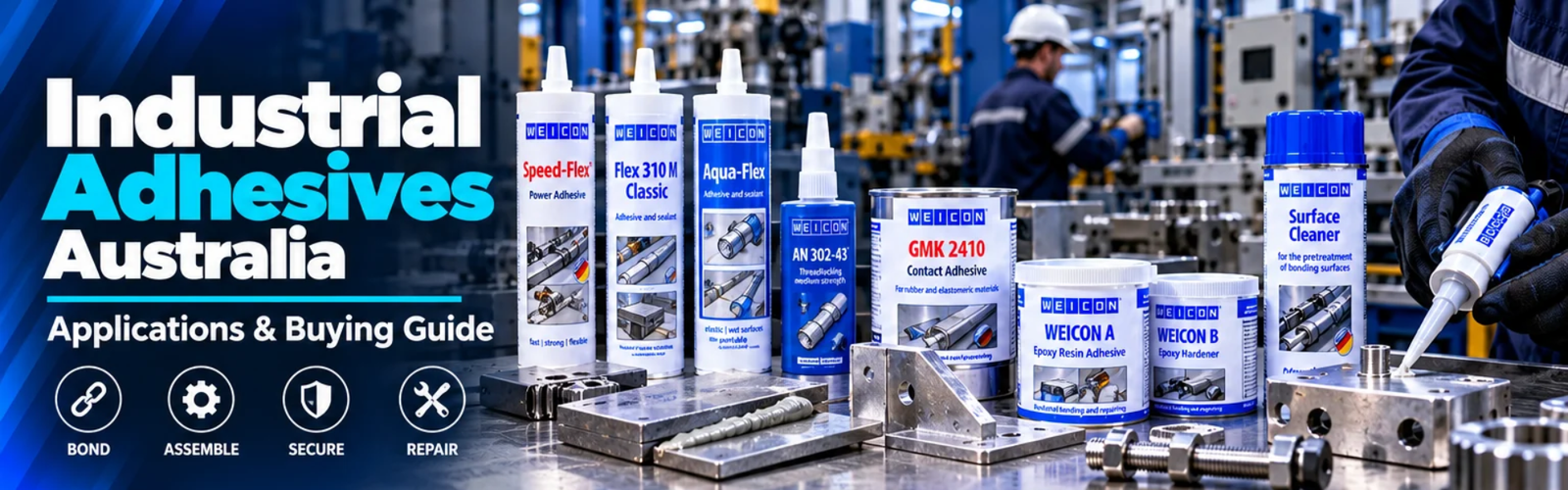
Industrial Adhesives Australia: Applications & Buying Guide
Admin
|
23 Oct 2026
|
12 min read
|
48 views
Industrial Adhesives Australia: Applications & Buying Guide
Industrial bonding has become an important part of modern manufacturing, engineering, maintenance and assembly.
While traditional fastening methods such as bolts, screws, rivets and welding remain essential for many applications, industrial adhesives can provide another way to join, seal, repair or secure components.
The right adhesive can be used in applications ranging from machine assembly and component bonding to maintenance, repair, electronics, automotive applications and industrial manufacturing.
However, choosing an industrial adhesive is very different from choosing a general-purpose glue.
Industrial environments can expose bonded components to:
- High temperatures
- Moisture
- Chemicals
- Vibration
- Mechanical loads
- Pressure
- Impact
- Oils and lubricants
- Outdoor conditions
- Continuous operation
The adhesive therefore needs to be selected according to the actual application and operating conditions.
This guide explains the major types of industrial adhesives in Australia, their applications, important selection criteria and common mistakes to avoid when purchasing an industrial adhesive.
What Are Industrial Adhesives?
Industrial adhesives are specialised bonding products designed to join two or more materials in manufacturing, engineering, maintenance, assembly and repair applications.
Depending on the product, industrial adhesives can bond materials such as:
- Metals
- Plastics
- Rubber
- Glass
- Ceramics
- Composites
- Wood
- Painted surfaces
- Other industrial substrates
Industrial adhesives can be supplied in different forms and technologies, including:
- Structural adhesives
- Instant adhesives
- Epoxy adhesives
- Anaerobic adhesives
- Threadlocking adhesives
- Silicone adhesives
- Polyurethane adhesives
- Cyanoacrylate adhesives
- Specialised repair adhesives
The correct choice depends on the materials being bonded and the conditions the finished assembly will experience.
Why Use Industrial Adhesives?
Industrial adhesives can provide several advantages depending on the application.
1. Joining Different Materials
Adhesives can sometimes join materials that are difficult to connect using conventional mechanical fastening methods.
For example, an application may involve bonding:
Metal → Plastic
or
Metal → Rubber
or
Plastic → Composite
The suitability depends on the specific adhesive and substrates.
2. Even Load Distribution
Unlike a point fastening system, an adhesive can distribute bonding forces across a larger surface area.
This can be useful for certain assemblies where stress concentration needs to be considered.
3. Reduced Mechanical Fasteners
In suitable applications, adhesives can reduce dependence on:
- Screws
- Bolts
- Rivets
- Other mechanical fasteners
However, adhesives should not automatically replace mechanical fastening.
The correct joining method depends on the engineering requirements of the application.
4. Sealing and Bonding
Some adhesive products can also provide sealing functions.
This can be useful where an assembly requires both:
Bonding + Sealing
5. Cleaner Assembly
Depending on the application, adhesive bonding can produce an assembly without visible fasteners.
This can be useful for certain equipment, components and manufactured products.
Major Types of Industrial Adhesives
There is no single industrial adhesive suitable for every application.
Different adhesive technologies have different properties.
1. Epoxy Adhesives
Epoxy adhesives are widely used for industrial bonding and repair applications.
They can be used for applications involving materials such as:
- Metal
- Plastic
- Composite materials
- Ceramics
- Other substrates
Depending on the formulation, epoxy adhesives can provide strong bonds and may offer resistance to environmental conditions.
Typical applications include:
- Machinery repair
- Component assembly
- Industrial manufacturing
- Structural bonding
- Equipment maintenance
2. Cyanoacrylate Adhesives
Cyanoacrylate adhesives are commonly known as instant adhesives.
They are designed for rapid bonding and can be useful when quick assembly is required.
Applications can include:
- Small components
- Rubber parts
- Plastics
- Metal components
- Electronics-related assembly
The substrate and application should always be checked before selecting a cyanoacrylate adhesive.
3. Anaerobic Adhesives
Anaerobic adhesives are commonly used for specific mechanical assembly applications.
They can be useful for:
- Threadlocking
- Thread sealing
- Retaining cylindrical components
- Flange sealing
They are particularly relevant to machinery and engineering applications.
4. Threadlocking Adhesives
Threadlocking products are designed to help secure threaded connections.
They may be used in applications where vibration or movement could cause threaded fasteners to loosen.
Potential applications include:
- Machinery
- Pumps
- Motors
- Industrial equipment
- Automotive components
Different threadlocking products can provide different levels of holding strength.
The correct product should therefore be selected according to the fastening requirements.
5. Structural Adhesives
Structural adhesives are designed for applications where the bonded joint needs to withstand significant mechanical requirements.
Depending on the product, they may be used for:
- Industrial assembly
- Machine building
- Component bonding
- Engineering applications
- Manufacturing
Structural adhesive selection should involve careful consideration of load, substrate, temperature and environmental exposure.
6. Silicone Adhesives and Sealants
Silicone-based products can be used for bonding and sealing applications.
They may be suitable for applications requiring flexibility and environmental resistance, depending on the formulation.
Typical applications can include:
- Sealing
- Component assembly
- Equipment maintenance
- Industrial manufacturing
7. Polyurethane Adhesives
Polyurethane adhesives can be used for bonding applications where flexibility and durability are important.
Depending on the formulation, they can be used with different industrial materials.
Applications may include:
- Manufacturing
- Assembly
- Construction-related applications
- Industrial bonding
- Component repair
8. High-Temperature Adhesives
Some industrial applications involve elevated operating temperatures.
Examples include:
- Machinery
- Engines
- Industrial equipment
- Heating systems
- Manufacturing processes
For these applications, the adhesive must be selected according to the actual operating temperature and exposure duration.
A product that works at room temperature may not be appropriate for high-temperature service.
Choosing an Industrial Adhesive by Material
One of the most important factors when selecting an adhesive is the material being bonded.
Metal Adhesives
Industrial metal adhesives may be used for:
- Steel
- Stainless steel
- Aluminium
- Cast metals
- Other metal substrates
Applications can include:
- Machinery
- Equipment repair
- Component assembly
- Manufacturing
Before bonding metal, surface preparation is often critical.
Plastic Adhesives
Different plastics have very different surface properties.
An adhesive that works well with one plastic may not be suitable for another.
When selecting an adhesive for plastics, identify the exact material where possible.
Consider:
- Plastic type
- Surface condition
- Flexibility
- Temperature
- Chemical exposure
Rubber Adhesives
Rubber bonding can present unique challenges because rubber materials can be flexible and have different surface characteristics.
Applications may include:
- Seals
- Components
- Industrial equipment
- Rubber parts
The adhesive must be compatible with both the rubber and the operating environment.
Glass Adhesives
Glass bonding may require specialised products depending on:
- Transparency requirements
- Temperature
- Moisture
- Mechanical loading
- Surface condition
Composite Adhesives
Composite materials are increasingly used in industrial and engineering applications.
The adhesive should be selected according to the specific composite and surface characteristics.
Industrial Adhesive Applications
Industrial adhesives can be used across a wide range of applications.
1. Machinery Assembly
Adhesives can be used in machinery assembly for:
- Component bonding
- Threadlocking
- Sealing
- Retaining
- Repair
2. Industrial Maintenance
Maintenance teams can use specialised adhesives for:
- Equipment repair
- Component replacement
- Threadlocking
- Sealing
- Bonding
3. Electrical and Automation
Certain adhesive and sealing products can be useful around:
- Control panels
- Electrical components
- Cable-related applications
- Automation equipment
Product selection should always consider electrical compatibility and the specific application.
4. Automotive Applications
Industrial adhesives can be used in selected automotive applications for:
- Component assembly
- Threadlocking
- Sealing
- Repair
- Bonding
The specific adhesive must meet the requirements of the application.
5. Manufacturing
Manufacturing businesses can use adhesives for:
- Assembly
- Product construction
- Component bonding
- Sealing
- Repair
- Production processes
6. Engineering Workshops
Engineering workshops often require adhesives for:
- Repairs
- Prototyping
- Component assembly
- Maintenance
- Machine building
7. Pumps and Fluid Equipment
Certain adhesive and sealing products can be used for:
- Thread sealing
- Flange sealing
- Component assembly
- Retaining applications
These applications require careful consideration of pressure, temperature and chemical compatibility.
8. Electronics
Specialised adhesives may be used in certain electronics applications for:
- Component bonding
- Protection
- Assembly
- Insulation-related applications
Electrical and thermal requirements must be considered before selecting a product.
Industrial Adhesives for Manufacturing
Manufacturing businesses often require adhesives that provide reliable and repeatable bonding.
Production environments may involve:
- High production volumes
- Repetitive assembly
- Tight production schedules
- Automated dispensing
- Consistent curing requirements
When selecting an adhesive for manufacturing, consider not only bond strength but also:
- Application speed
- Cure time
- Dispensing method
- Shelf life
- Storage
- Production temperature
- Automation compatibility
Industrial Adhesives for Maintenance and Repair
Maintenance applications can be different from manufacturing.
A maintenance technician may need an adhesive immediately to repair:
- Machinery
- Components
- Housings
- Threaded connections
- Pipes
- Industrial equipment
For maintenance teams, product availability and ease of application can be particularly important.
Surface Preparation Before Adhesive Application
Even a high-performance adhesive can perform poorly if the surfaces are not properly prepared.
Surface preparation may involve:
Cleaning
Remove:
- Oil
- Grease
- Dust
- Dirt
- Existing residues
Drying
Ensure the surface is suitable for the adhesive.
Surface Treatment
Some materials may require additional preparation to improve adhesion.
Mechanical Preparation
Depending on the application, light abrasion or other preparation methods may be appropriate.
Always follow the manufacturer's instructions for the specific adhesive.
Why Surface Preparation Matters
Adhesive performance depends on the interaction between the adhesive and the substrate.
Contamination can interfere with this interaction.
Common contaminants include:
- Oil
- Grease
- Dust
- Moisture
- Paint
- Oxidation
- Existing adhesive
A carefully prepared surface can improve consistency and reduce bonding problems.
Important Factors When Buying Industrial Adhesives in Australia
When purchasing industrial adhesives in Australia, consider the following factors.
1. Bonded Materials
Identify exactly what materials need to be joined.
2. Required Bond Strength
Determine what mechanical forces the joint will experience.
These may include:
- Tension
- Compression
- Shear
- Peel
- Impact
3. Operating Temperature
Check both:
- Minimum operating temperature
- Maximum operating temperature
4. Chemical Exposure
Will the adhesive be exposed to:
- Oil?
- Fuel?
- Water?
- Cleaning chemicals?
- Solvents?
- Industrial chemicals?
Chemical resistance can be critical in industrial applications.
5. Cure Time
Consider how quickly the assembly needs to be ready.
Some adhesives cure rapidly, while others require longer curing periods.
6. Working Time
The available working time can be important for larger assemblies.
7. Application Method
Determine how the adhesive will be applied.
Possibilities may include:
- Manual application
- Cartridge dispensing
- Automated dispensing
- Spray application
- Specialised applicators
8. Viscosity
Viscosity affects how the adhesive behaves during application.
A low-viscosity product may flow differently from a high-viscosity product.
The correct viscosity depends on:
- Surface orientation
- Gap size
- Application method
- Required coverage
Industrial Adhesive Strength: What Does It Mean?
A common mistake is to assume that the adhesive with the highest advertised strength is automatically the best adhesive.
That's not necessarily true.
An adhesive must be appropriate for the actual joint.
For example, a joint may experience:
- Shear
- Peel
- Vibration
- Thermal expansion
- Impact
The adhesive should therefore be selected according to the complete application rather than one strength number.
Adhesive Bonding vs Mechanical Fastening
Both methods have their place in industrial engineering.
Adhesive Bonding
Potential benefits include:
- Distributed load
- Joining different materials
- Sealing capability
- Reduced visible fasteners
- Suitable for some complex geometries
Mechanical Fastening
Potential benefits include:
- Easy disassembly
- Established installation methods
- High mechanical reliability in suitable applications
- Suitable for many heavy-duty applications
Combination Approach
Some applications may use both.
For example:
Mechanical fastening + adhesive/sealant
The correct method depends on the engineering requirements.
Common Industrial Adhesive Mistakes
Choosing Based Only on Bond Strength
A high-strength adhesive may not be suitable for every material or environment.
Ignoring Surface Preparation
Dirty or contaminated surfaces can compromise the bond.
Ignoring Temperature
Always check the actual operating temperature.
Using the Wrong Adhesive for the Material
Different substrates require different adhesive technologies.
Not Allowing Proper Cure Time
Moving a bonded assembly before sufficient curing can compromise performance.
Ignoring Shelf Life
Industrial adhesives can have specific storage and shelf-life requirements.
Buying Without Checking Technical Documentation
Product specifications should always be reviewed before industrial use.
Industrial Adhesive Storage
Proper storage is important for maintaining product performance.
Storage requirements depend on the specific adhesive.
Consider:
- Temperature
- Humidity
- Direct sunlight
- Container condition
- Shelf life
- Manufacturer recommendations
Always follow the manufacturer's storage instructions.
Industrial Adhesives Australia: Why Supplier Support Matters
Buying an industrial adhesive isn't simply about finding a product online.
Businesses may need help answering questions such as:
- Which adhesive is suitable for this material?
- Is it suitable for the operating temperature?
- How should the surface be prepared?
- How long does it take to cure?
- Is it suitable for chemical exposure?
- What application method should be used?
A specialist industrial supplier can help customers identify products according to their application requirements.
Why Choose Spleca for Industrial Adhesives in Australia?
Spleca supplies industrial products and solutions to businesses across Australia.
Our product range covers areas including:
- Industrial automation
- Industrial maintenance
- WEICON products
- Technical sprays
- Chemical products
- Industrial tools
- Adhesives
- Engineering solutions
For customers searching for industrial adhesives in Australia, Spleca provides access to specialist industrial products designed for professional applications.
Our objective is to make industrial product sourcing easier by helping customers find suitable products for their specific requirements.
Whether you are a:
- Manufacturer
- Maintenance team
- Engineer
- OEM
- Electrical contractor
- Machine builder
- Workshop
- Industrial buyer
we can help you explore suitable industrial adhesive solutions.
Industrial Adhesive Buying Checklist
Before purchasing an adhesive, confirm:
- Material being bonded
- Required bond strength
- Joint design
- Operating temperature
- Chemical exposure
- Moisture exposure
- Vibration
- Impact
- Required cure time
- Working time
- Application method
- Adhesive viscosity
- Surface preparation requirements
- Storage requirements
- Shelf life
- Product documentation
- Product availability
- Supplier support
Frequently Asked Questions
What are industrial adhesives?
Industrial adhesives are specialised bonding products designed for manufacturing, engineering, maintenance, assembly and repair applications.
What materials can industrial adhesives bond?
Depending on the adhesive, they may bond metals, plastics, rubber, glass, ceramics, composites and other industrial materials.
What is the best industrial adhesive?
There is no single best industrial adhesive for every application. The correct product depends on the materials, joint design, temperature, chemical exposure, mechanical requirements and application method.
Where can I buy industrial adhesives in Australia?
Industrial adhesives can be purchased through specialist industrial suppliers and distributors that provide genuine products and technical information.
Can industrial adhesives replace bolts and screws?
In some applications, adhesives can reduce or replace mechanical fasteners, but this depends entirely on the engineering requirements of the joint.
What is an epoxy adhesive?
Epoxy adhesives are two-part or specialised adhesive systems commonly used for industrial bonding and repair applications.
What are threadlocking adhesives used for?
Threadlocking adhesives are used to secure threaded connections and can help prevent unwanted loosening in suitable applications.
Why is surface preparation important?
Oil, grease, dust, moisture and other contaminants can interfere with adhesive bonding. Proper surface preparation can improve bonding consistency.
How long does an industrial adhesive take to cure?
Cure time varies significantly depending on the adhesive technology, product, temperature, substrate and application. Always follow the manufacturer's technical instructions.
Are industrial adhesives resistant to chemicals?
Some industrial adhesives are formulated for chemical resistance, but resistance varies by product and chemical. Check the technical documentation before use.
Can industrial adhesives be used outdoors?
Some products may be suitable for outdoor applications, while others may not. Environmental exposure such as UV, moisture and temperature should be considered.
What should I consider when buying industrial adhesives?
Consider the substrate, bond requirements, operating temperature, chemical exposure, cure time, surface preparation, application method and environmental conditions.
Conclusion
Industrial adhesives have become an important solution for modern manufacturing, maintenance, engineering and assembly applications.
From metal bonding and plastic assembly to machinery repair, threadlocking, sealing and industrial maintenance, the right adhesive can provide a practical alternative or complement to conventional joining methods.
However, adhesive selection should always be application-driven.
The correct product depends on:
Material + Joint + Environment + Load + Temperature + Application Method
Before purchasing an industrial adhesive, identify the materials being bonded, understand the operating conditions and review the manufacturer's technical specifications.
For Australian businesses, sourcing through an experienced industrial supplier can make the selection process easier and provide access to specialist products and technical support.
Spleca supplies industrial adhesives, WEICON products, technical sprays, chemical products, tools and industrial automation solutions across Australia.
Looking for the right adhesive for your industrial application?
Explore Spleca's industrial adhesive range or contact our team for assistance.
Explore Spleca
Browse Industrial Adhesives →
Explore WEICON Products →
View WEICON Tools →
Explore Technical Sprays →
Explore Chemical Products →
Browse Industrial Automation Products →
Contact Spleca →
Explore Industrial Automation Products