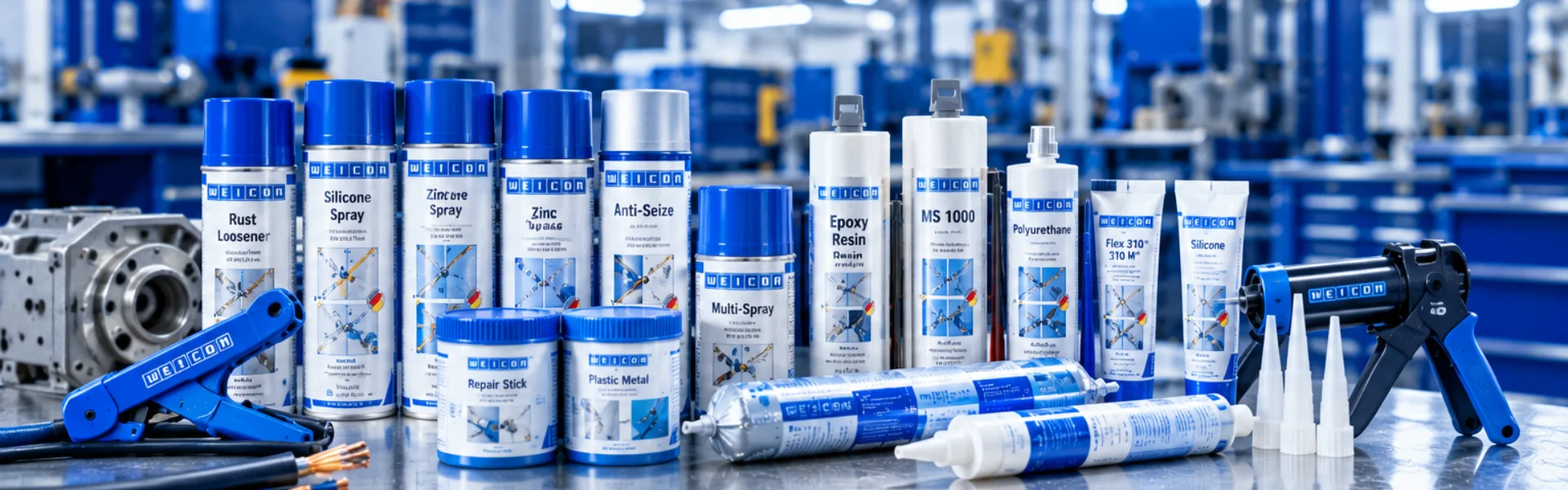
Industrial Sealants: Types & Applications
Admin
|
06 Oct 2026
|
17 min read
|
23 views
Industrial Sealants: Types & Applications
Industrial equipment relies on countless joints, connections, pipes, housings, flanges and components that need to remain secure and leak-free during operation.
Even when two components appear to fit tightly together, microscopic gaps can exist between their surfaces.
These gaps can potentially allow:
- Water
- Air
- Gas
- Oil
- Fuel
- Hydraulic fluids
- Process chemicals
- Other liquids or gases
to escape from a connection.
This is where industrial sealants play an important role.
Industrial sealants are specialised products used to seal joints, connections, threaded fittings, flanges, housings and other interfaces where preventing leakage or protecting an assembly is important.
Depending on the technology, industrial sealants can also provide additional functions such as:
- Thread sealing
- Flange sealing
- Gasketing
- Bonding
- Vibration resistance
- Temperature resistance
- Chemical resistance
- Corrosion protection
Different sealing applications require different technologies.
A sealant designed for a threaded pipe connection isn't automatically the correct product for a flange.
Likewise, a silicone sealant isn't automatically the right choice for a hydraulic connection.
This is why understanding industrial sealant types, applications and selection criteria is important for engineers, maintenance teams and industrial businesses.
What Are Industrial Sealants?
Industrial sealants are materials designed to close or seal gaps between surfaces and help prevent the passage of liquids, gases or other substances through a joint or connection.
They can be used in:
- Manufacturing
- Mechanical engineering
- Automotive
- Mining
- Oil and gas
- Energy
- Construction
- Marine
- Food processing
- Electrical applications
- Industrial maintenance
Industrial sealants can be applied to different types of joints, including:
- Threaded connections
- Flanges
- Housings
- Joints
- Seams
- Pipe fittings
- Equipment surfaces
The correct sealant depends on the application.
Why Are Industrial Sealants Important?
A leaking connection can cause much more than a small inconvenience.
Depending on the equipment, leakage can lead to:
- Product loss
- Pressure loss
- Equipment contamination
- Corrosion
- Downtime
- Maintenance costs
- Safety concerns
- Environmental issues
For example, a small leak in a compressed-air system can contribute to energy losses.
A hydraulic leak can affect equipment performance.
A process-fluid leak can contaminate surrounding equipment.
A leaking flange can cause repeated maintenance.
Industrial sealants are therefore an important part of equipment assembly and maintenance.
Industrial Sealant vs Industrial Adhesive
Industrial sealants and industrial adhesives can overlap, but their primary purposes are different.
Adhesive
The primary purpose is generally:
Joining two surfaces.
Sealant
The primary purpose is generally:
Sealing a gap or joint against leakage or environmental exposure.
Some products can perform both functions.
For example, certain silicone, MS polymer, polyurethane and hybrid systems can provide both bonding and sealing.
However, you should always select the product according to its specified application.
Main Types of Industrial Sealants
Industrial sealing technologies include several major categories:
- Anaerobic thread sealants
- Pipe and thread sealants
- Flange sealants
- Silicone sealants
- High-temperature silicone sealants
- MS polymer sealants
- Polyurethane sealants
- Hybrid sealants
- Gasketing compounds
- Specialised chemical-resistant sealants
The right type depends on:
Joint + Material + Temperature + Pressure + Media + Environment
1. Anaerobic Sealants
Anaerobic sealants are commonly used for suitable metal assemblies.
They cure in conditions where oxygen is excluded and the product comes into contact with suitable metal surfaces.
WEICON describes its WEICONLOCK range as anaerobic-curing, one-component adhesives and sealants designed for metal joints. The range includes products for threadlocking, pipe/thread sealing, retaining and flange sealing/gasketing. (weicon.de)
Anaerobic technology can therefore be particularly useful for industrial sealing applications involving:
- Threads
- Pipes
- Fittings
- Flanges
- Cylindrical assemblies
2. Pipe and Thread Sealants
Pipe and thread sealants are designed specifically for suitable threaded pipe connections and fittings.
Their primary purpose is to help prevent:
- Fluid leakage
- Gas leakage
- Pressure loss
Applications can include:
- Hydraulic systems
- Pneumatic systems
- Industrial piping
- Water connections
- Process equipment
- Energy systems
- Oil and gas systems
WEICON's pipe and thread sealant range is designed for sealing threaded pipes and fittings. (weicon.de)
How Pipe Thread Sealants Work
A threaded connection contains microscopic spaces between the mating threads.
A suitable sealant fills these spaces.
The general process is:
Clean → Apply → Assemble → Cure
The final result is intended to prevent leakage through the threaded interface.
WEICONLOCK AN 305-11, for example, is applied around the thread before the pipe thread is assembled and tightened to the required alignment. (media.weicon.de)
3. Flange Sealants
Flanges are widely used in industrial equipment and piping systems.
A flange connection typically joins two surfaces together with a sealing interface between them.
Flange sealants can be used where a suitable liquid gasket or gasketing compound is required.
Applications can include:
- Pumps
- Gearboxes
- Machine housings
- Engines
- Industrial equipment
- Pipe systems
- Mechanical assemblies
WEICON includes flange sealing and gasketing as a distinct category within its WEICONLOCK anaerobic product family. (weicon.de)
What Is Liquid Gasketing?
Liquid gasketing uses a sealant to create a sealing layer between mating surfaces.
Instead of using a pre-cut gasket, the liquid product forms a gasket-like seal after application and curing.
This can be useful for suitable:
- Flanges
- Housings
- Covers
- Machine components
The specific product should be selected according to the joint and operating conditions.
4. Silicone Sealants
Silicone sealants are widely used for industrial sealing applications.
Depending on the formulation, silicone systems can provide:
- Flexibility
- Weather resistance
- Temperature resistance
- Sealing performance
- Adhesion to suitable substrates
Potential applications include:
- Industrial equipment
- Machinery
- Electrical equipment
- Enclosures
- Heating systems
- Construction
- Maintenance
WEICON's adhesives and sealants portfolio includes silicone systems alongside MS polymers, instant adhesives, threadlockers, epoxy adhesives and other technologies. (weicon.de)
5. High-Temperature Sealants
Some industrial environments operate at elevated temperatures.
Examples include:
- Engines
- Industrial heaters
- Furnaces
- Exhaust systems
- Machinery
- Heating equipment
Standard sealants may not be suitable for these applications.
Specialised high-temperature products should therefore be considered.
WEICON Silicone HT 300 is an example of a high-temperature-resistant silicone sealant listed for temperatures up to 300°C. (weicon.de)
Why Temperature Matters
When selecting a high-temperature industrial sealant, don't look only at the maximum temperature.
Consider:
- Continuous operating temperature
- Maximum temperature
- Temperature cycles
- Heating and cooling frequency
- Pressure at temperature
- Chemical exposure at temperature
A product that performs well at room temperature may behave differently at elevated temperatures.
6. MS Polymer Sealants
MS polymers are hybrid adhesive and sealant technologies.
They can provide a combination of:
- Adhesion
- Flexibility
- Sealing
- Weather resistance
- Mechanical performance
WEICON includes MS polymers among its one-component adhesive and sealant technologies. (weicon.de)
They can be useful where the joint needs some flexibility rather than forming an extremely rigid connection.
7. Polyurethane Sealants
Polyurethane sealants can provide flexible sealing and bonding characteristics.
Depending on the formulation, they may be useful where joints experience:
- Movement
- Vibration
- Mechanical stress
- Environmental exposure
WEICON includes urethane systems within its two-component adhesive and sealant portfolio. (weicon.de)
8. Hybrid Sealants
Hybrid sealants combine characteristics from different adhesive/sealant technologies.
Depending on the product, they may provide:
- Adhesion
- Flexibility
- Weather resistance
- Sealing
- Chemical resistance
Hybrid products can be useful where a joint needs both bonding and sealing characteristics.
9. Chemical-Resistant Sealants
Industrial equipment can encounter aggressive substances.
These can include:
- Oils
- Fuels
- Solvents
- Acids
- Alkalis
- Cleaning chemicals
- Process fluids
When chemical exposure is expected, the sealant should be selected based on the specific chemical and operating conditions.
Never assume that a product described as "chemical resistant" is suitable for every chemical.
10. Specialised Industrial Sealants
Some applications require highly specific sealing products.
Examples include:
- Drinking-water systems
- Hydraulic systems
- Pneumatic systems
- High-temperature systems
- Oil and gas equipment
- Chemical processing
- Marine equipment
These applications can involve specific regulatory, technical or safety requirements.
Always check the individual product documentation.
Industrial Sealant Applications
Industrial sealants are used across many industries.
Mechanical Engineering
Mechanical equipment contains numerous sealing points.
Examples include:
- Machine housings
- Flanges
- Gearboxes
- Pumps
- Motors
- Covers
- Threaded connections
Sealants can help prevent leakage and protect assemblies.
WEICON identifies mechanical engineering among the application areas for its adhesive and sealing technologies. (weicon.de)
Manufacturing
Manufacturing equipment may require sealants during:
- Assembly
- Maintenance
- Repair
- Machine construction
- Component installation
Sealants can help create reliable joints between suitable components.
Automotive
Automotive equipment contains many joints that may require sealing.
Potential applications include:
- Engine components
- Gearboxes
- Housings
- Pumps
- Threaded connections
- Electrical enclosures
The selected product must match the operating temperature, fluids and materials involved.
WEICON identifies automotive and transport among its industrial application areas. (weicon.de)
Mining
Mining environments can be particularly demanding.
Equipment may experience:
- Dust
- Water
- Vibration
- Abrasion
- Corrosion
- Heavy loads
Industrial sealing products can support appropriate maintenance and equipment protection.
WEICON identifies mining and conveyor technology among application areas for its epoxy and sealing solutions. (weicon.de)
Oil and Gas
Oil and gas equipment can involve:
- High pressure
- Hydrocarbons
- Aggressive chemicals
- Elevated temperatures
- Complex piping
Thread and flange sealing can therefore be critical.
WEICON's pipe and thread sealing solutions include oil and gas among their application areas. (weicon.de)
Hydraulic Systems
Hydraulic equipment uses pressurised fluids.
Connections may include:
- Pipe threads
- Fittings
- Valves
- Pumps
- Hydraulic components
A suitable thread sealant can help prevent fluid leakage through threaded connections.
WEICON identifies hydraulic systems among applications for its pipe and thread sealing products. (weicon.de)
Pneumatic Systems
Pneumatic systems depend on compressed air or other gases.
Even small leaks can affect system performance.
Industrial thread sealants can be used for suitable threaded connections.
Again, product compatibility must be verified.
Energy
Energy infrastructure can include:
- Pumps
- Pipes
- Valves
- Flanges
- Machinery
- Electrical equipment
Industrial sealing products can support suitable maintenance and assembly requirements.
WEICON identifies energy among its application areas for bonding and sealing products. (weicon.de)
Marine and Offshore
Marine environments introduce additional challenges:
- Salt water
- Moisture
- Corrosion
- Vibration
- Temperature variation
Sealant selection should account for the complete environment.
WEICON identifies maritime applications among its industrial application areas. (weicon.de)
Food and Beverage
Food-processing equipment has additional requirements.
Depending on the application, the sealant may need specific:
- Regulatory approvals
- Temperature resistance
- Cleaning resistance
- Chemical resistance
Never assume that an industrial sealant is suitable for food-contact or drinking-water applications without verifying the applicable approval.
For example, WEICON identifies products within its portfolio with specific approvals for certain applications, including drinking-water use. (weicon.de)
Chemical Processing
Chemical processing equipment can expose sealants to aggressive media.
Selection should consider:
- Chemical type
- Concentration
- Temperature
- Pressure
- Exposure duration
Chemical compatibility should always be confirmed from the technical documentation.
Electrical Equipment
Sealants can be used around suitable electrical equipment for:
- Enclosure sealing
- Moisture protection
- Component sealing
- Cable-entry sealing
The sealant must be compatible with the materials and electrical requirements.
Industrial Sealants for Maintenance
Maintenance teams use sealants to address problems such as:
- Leaking threads
- Leaking flanges
- Damaged sealing surfaces
- Housing leaks
- Joint deterioration
- Component sealing
The correct product can help reduce unnecessary equipment downtime.
Thread Sealant vs Threadlocker
These two products are commonly confused.
Threadlocker
Primary purpose:
Prevent threaded fasteners from loosening.
Thread sealant
Primary purpose:
Prevent leakage through threaded pipes and fittings.
WEICON separates these applications within its WEICONLOCK range. (weicon.de)
For a detailed comparison, see:
Threadlocker vs Thread Sealant: What's the Difference?
Flange Sealant vs Thread Sealant
A threaded connection and a flange connection are different.
Thread sealant
Used on suitable:
Pipe threads + fittings
Flange sealant
Used on suitable:
Mating flange surfaces
Using the wrong product can result in poor sealing.
Industrial Sealant vs Gasket
A traditional gasket is a pre-formed sealing component.
A liquid gasket or flange sealant is applied directly to the mating surfaces.
The correct choice depends on:
- Joint design
- Temperature
- Pressure
- Maintenance requirements
- Equipment design
Some industrial applications can use liquid gasketing instead of conventional pre-cut gaskets.
Benefits of Industrial Sealants
Industrial sealants can provide several benefits.
1. Leak Prevention
The most fundamental purpose of a sealant is to help prevent leakage.
This can involve:
- Liquids
- Gases
- Oils
- Fuels
- Hydraulic fluids
2. Vibration Resistance
Certain sealant technologies can maintain sealing performance under vibration and movement.
The actual performance depends on the product and joint design.
3. Chemical Resistance
Specialised sealants can be selected for suitable exposure to:
- Oils
- Fuels
- Solvents
- Chemicals
4. Temperature Resistance
Specialised products can operate in elevated-temperature environments.
For example, WEICON Silicone HT 300 is specified for high-temperature applications up to 300°C. (weicon.de)
5. Reduced Maintenance
Reliable sealing can help reduce recurring leaks and associated maintenance work.
6. Flexible Sealing
Flexible sealants can accommodate certain movement and thermal expansion.
7. Bonding and Sealing
Some products can perform both functions.
This can be useful in applications where a component needs to be attached and sealed simultaneously.
8. Corrosion Protection
By preventing moisture or contaminants from reaching certain joint interfaces, sealing can contribute to protection against environmental exposure.
The actual corrosion-protection performance depends on the product and application.
How to Choose the Right Industrial Sealant
Choosing an industrial sealant should begin with the application.
Step 1 — Identify the Joint
Is it:
- Threaded?
- Flanged?
- Flat?
- Flexible?
- Cylindrical?
- Housing-based?
Step 2 — Identify the Materials
Determine whether the surfaces are:
- Steel
- Stainless steel
- Aluminium
- Brass
- Plastic
- Rubber
- Composite
- Glass
Step 3 — Identify the Media
What must be contained?
- Water
- Air
- Gas
- Oil
- Fuel
- Hydraulic fluid
- Chemicals
- Steam
Step 4 — Determine Pressure
Determine:
- Normal pressure
- Maximum pressure
- Pressure cycles
Step 5 — Determine Temperature
Identify:
- Minimum temperature
- Normal operating temperature
- Maximum temperature
- Temperature cycling
Step 6 — Consider Movement
Does the joint experience:
- Vibration?
- Thermal expansion?
- Mechanical movement?
- Flexing?
Step 7 — Determine Cure Requirements
Ask:
How quickly does the equipment need to return to service?
Step 8 — Determine Removability
Will the connection need to be dismantled later?
Step 9 — Check Approvals
For specialised applications, check whether you need:
- Drinking-water approval
- Food-related approval
- Gas approval
- Chemical compatibility
- Industry-specific certification
Step 10 — Review Technical Documentation
Before using the sealant, review:
- Technical Data Sheet
- Safety Data Sheet
- Application instructions
- Temperature range
- Chemical compatibility
- Cure time
- Pressure suitability
- Substrate compatibility
Industrial Sealant Selection Table
| Application | Sealant Technology to Consider |
| Pipe threads | Anaerobic thread sealant |
| Threaded fittings | Pipe/thread sealant |
| Flanges | Flange sealant / liquid gasket |
| High-temperature sealing | High-temperature silicone / specialised sealant |
| Flexible joints | Silicone / MS polymer / polyurethane |
| Mechanical housings | Suitable flange sealant |
| Hydraulic connections | Suitable pipe/thread sealant |
| Pneumatic connections | Suitable pipe/thread sealant |
| Chemical systems | Chemically compatible specialised sealant |
| General industrial sealing | Application-specific industrial sealant |
This table is a starting point only. The actual product should always be selected using technical documentation.
Anaerobic Sealant vs Silicone Sealant
These technologies are designed for different applications.
Anaerobic sealants
Often suited to:
- Metal threaded connections
- Pipe threads
- Flanges
- Cylindrical assemblies
Silicone sealants
Often suited to:
- Flexible joints
- General sealing
- Environmental sealing
- High-temperature applications depending on product
The exact application determines which technology is appropriate.
High-Temperature Industrial Sealants
High-temperature sealing requires careful product selection.
Ask:
- What is the continuous temperature?
- What is the peak temperature?
- Is pressure present?
- Is the joint rigid or flexible?
- Are chemicals present?
- Is vibration present?
WEICON Silicone HT 300, for example, is designed for high-temperature sealing and is specified up to 300°C. (weicon.de)
Industrial Sealants for Pressurised Systems
Pressure introduces additional requirements.
Potential applications include:
- Hydraulic systems
- Pneumatic systems
- Gas systems
- Process piping
Before selecting a sealant, determine:
Pressure + Media + Temperature + Thread + Material
All five can influence product selection.
Industrial Sealants for Chemicals
If a sealant will be exposed to chemicals, don't rely on generic marketing descriptions.
Identify:
Chemical
Concentration
Temperature
Exposure duration
Then verify compatibility.
Industrial Sealants for Water
Water applications can vary significantly.
For example:
- Industrial water
- Cooling water
- Process water
- Potable water
These applications may have different requirements.
If the application involves drinking water, verify the specific product approval.
Industrial Sealants for Oil and Fuel
Oil and fuel exposure can affect sealant performance.
Consider:
- Type of fluid
- Temperature
- Pressure
- Exposure duration
- Material compatibility
Select a product with documented suitability for the application.
Industrial Sealants for Vibration
Machinery may experience continuous vibration.
Sealants may need to accommodate movement while maintaining the seal.
Applications can include:
- Pumps
- Motors
- Compressors
- Gearboxes
- Conveyors
The sealant technology should match the joint and expected movement.
Surface Preparation
Good surface preparation is essential.
A general process is:
Inspect → Clean → Degrease → Dry → Apply → Assemble → Cure
Depending on the application, additional surface preparation may be necessary.
Why Cleaning Matters
Surfaces can contain:
- Oil
- Grease
- Dust
- Rust
- Paint
- Moisture
- Previous sealant
These contaminants can interfere with sealing.
How Much Sealant Should You Apply?
There is no universal quantity.
It depends on:
- Joint type
- Gap
- Product viscosity
- Application method
- Manufacturer instructions
More sealant does not automatically mean better sealing.
Follow the product's application instructions.
Common Industrial Sealant Mistakes
Mistake 1 — Using the Wrong Sealant Type
A pipe sealant isn't automatically a flange sealant.
Mistake 2 — Ignoring Pressure
A product suitable for low-pressure applications may not be suitable for high-pressure systems.
Mistake 3 — Ignoring Temperature
Temperature can significantly affect sealant performance.
Mistake 4 — Ignoring the Media
Oil, fuel, water and chemicals can have very different compatibility requirements.
Mistake 5 — Poor Surface Preparation
Contaminated surfaces can compromise the seal.
Mistake 6 — Using Too Much Product
Excessive sealant can create unnecessary mess and may interfere with assembly.
Mistake 7 — Ignoring Cure Time
Equipment may need to remain out of service until the sealant has reached the required condition.
Mistake 8 — Choosing by Price Alone
Consider:
Sealant cost + labour + downtime + leakage + maintenance
rather than only the purchase price.
Industrial Sealants and Preventive Maintenance
Sealants can form part of a preventive-maintenance strategy.
Maintenance teams can inspect:
- Pipe joints
- Threaded connections
- Flanges
- Housings
- Sealing surfaces
for:
- Leakage
- Cracking
- Deterioration
- Corrosion
- Movement
Early detection can help prevent larger equipment problems.
Industrial Sealants and Equipment Downtime
A small leak can become a larger operational issue.
Depending on the application, leakage can result in:
- Reduced equipment efficiency
- Pressure loss
- Fluid loss
- Contamination
- Safety concerns
- Maintenance downtime
Selecting a suitable sealing solution during assembly or repair can therefore be an important part of equipment reliability.
WEICON Industrial Sealant Solutions
WEICON's adhesive and sealant portfolio covers multiple industrial sealing technologies.
These include:
- Pipe and thread sealants
- Threadlockers
- Flange sealants
- Silicone sealants
- MS polymers
- Urethanes
- Epoxy systems
- Other specialised adhesive/sealant technologies
WEICON's WEICONLOCK range specifically separates threadlocking, pipe/thread sealing, retaining and flange sealing/gasketing into different application categories. (weicon.de)
This application-based approach is important because the best sealing product depends on what you are actually trying to seal.
Example: Choosing a Sealant
Imagine a factory has four different sealing problems.
Problem 1
A hydraulic pipe fitting is leaking.
Requirement: Thread sealing.
Problem 2
A gearbox housing is leaking at the flange.
Requirement: Flange sealing.
Problem 3
A high-temperature industrial joint requires flexible sealing.
Requirement: High-temperature sealant.
Problem 4
A machine bolt is loosening because of vibration.
Requirement: Threadlocking.
These are four different problems.
They should not automatically use the same product.
Industrial Sealant Selection Checklist
Before selecting a sealant, record:
Application:
Joint type:
Material 1:
Material 2:
Media:
Pressure:
Operating temperature:
Maximum temperature:
Chemical exposure:
Movement/vibration:
Gap:
Required cure time:
Required flexibility:
Removability:
Required approvals:
Current product:
Photos:
This information can make technical product selection significantly easier.
Frequently Asked Questions
What are industrial sealants?
Industrial sealants are products used to seal gaps and joints in industrial equipment, machinery, piping and assemblies to help prevent leakage and environmental ingress.
What are the main types of industrial sealants?
Common technologies include anaerobic thread sealants, pipe and thread sealants, flange sealants, silicone sealants, MS polymer sealants, polyurethane sealants and specialised high-temperature or chemical-resistant sealants.
What is the difference between sealant and adhesive?
An adhesive is primarily intended to join surfaces, while a sealant is primarily intended to seal gaps or joints. Some products can perform both functions.
What is a thread sealant?
A thread sealant is designed to seal suitable threaded pipes and fittings against leakage.
What is a flange sealant?
A flange sealant is used on suitable mating flange surfaces to create a sealed joint.
What is anaerobic sealant?
An anaerobic sealant cures in suitable conditions where oxygen is excluded and the product contacts appropriate metal surfaces. WEICONLOCK is an example of an anaerobic adhesive and sealant product family. (weicon.de)
What sealant is best for high temperatures?
The correct product depends on the actual temperature and application. Specialised high-temperature products such as WEICON Silicone HT 300 are designed for elevated-temperature sealing applications. (weicon.de)
Can industrial sealants be used on pipes?
Yes. Specific pipe and thread sealing products are designed for suitable threaded pipe and fitting applications. (weicon.de)
Can industrial sealants be used for hydraulic systems?
Some products are specifically designed for suitable hydraulic applications. Always verify compatibility with the hydraulic fluid, pressure, temperature and materials.
Can industrial sealants be used for pneumatic systems?
Yes, suitable pipe and thread sealants can be used in appropriate pneumatic applications. Product compatibility should always be verified.
Are industrial sealants chemical resistant?
Some are. Chemical resistance depends on the specific product and chemical environment.
Are silicone sealants suitable for industrial applications?
Yes. Silicone technologies are used in many industrial sealing applications, including specialised high-temperature applications.
What is liquid gasketing?
Liquid gasketing uses a sealant applied to suitable mating surfaces to create a gasket-like sealing layer after application and curing.
Can a threadlocker be used as a sealant?
Some threadlocking products can provide sealing characteristics, but you should select a product according to its specified application. A dedicated thread sealant is generally the appropriate category when the primary requirement is pipe-thread sealing.
What is the difference between thread sealant and flange sealant?
Thread sealants are designed for suitable threaded connections, while flange sealants are designed for suitable mating flange surfaces.
How do I choose the right industrial sealant?
Start with the joint type, materials, media, pressure, temperature, chemical exposure, movement, gap, cure time and required approvals.
Why is surface preparation important?
Cleaning and appropriate preparation can help ensure that the sealant contacts the intended surfaces and performs as designed.
How long does industrial sealant take to cure?
Cure time varies significantly by product and technology. Always check the manufacturer's technical documentation.
Conclusion
Industrial sealants are an important part of manufacturing, engineering, maintenance and equipment reliability.
They can be used for:
Thread sealing
Flange sealing
Liquid gasketing
Flexible sealing
High-temperature sealing
Industrial maintenance
Leak prevention
The key is selecting the correct technology for the application.
A threaded pipe connection may require a thread sealant.
A vibrating bolt may require a threadlocker.
A flange may require a flange sealant.
A flexible joint may require a silicone, MS polymer or polyurethane-based system.
A high-temperature application may require a specialised high-temperature sealant.
The correct selection should always consider:
Joint + Material + Media + Pressure + Temperature + Movement + Gap + Cure Requirements
For Australian manufacturers, engineers, maintenance teams, OEMs and industrial businesses, Spleca provides access to industrial sealing solutions including WEICON products for suitable bonding, sealing, maintenance and repair applications.
Need help choosing the right industrial sealant?
Explore Industrial Automation Products