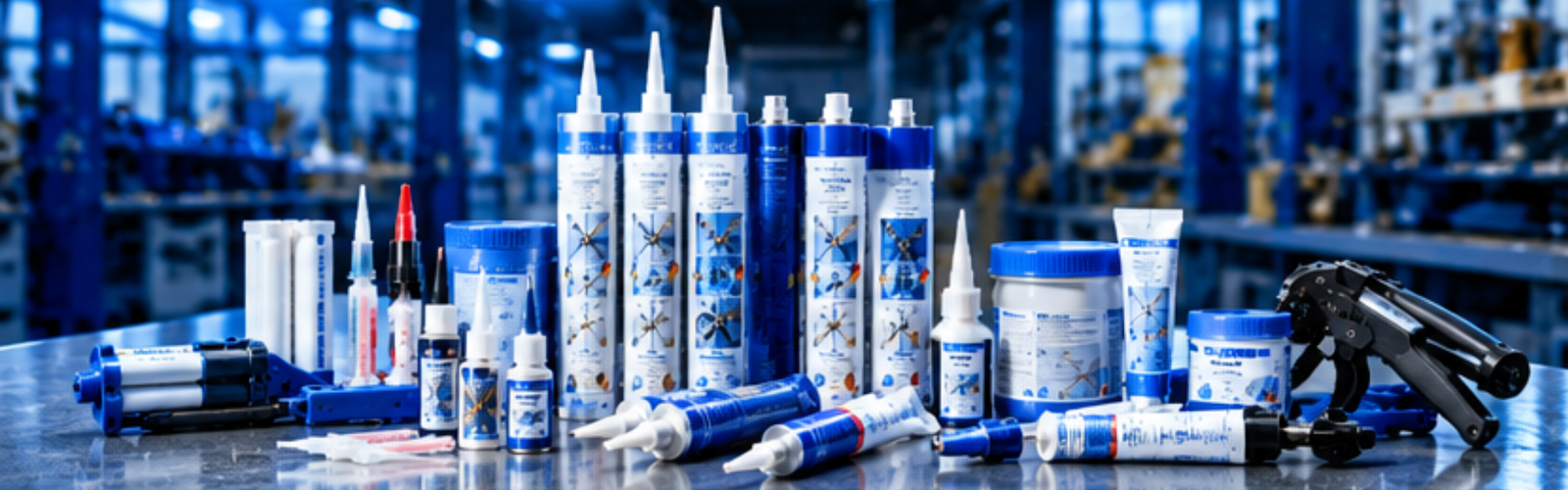
Industrial Adhesives: Types, Applications & Benefits
Admin
|
15 Sep 2026
|
19 min read
|
25 views
Industrial Adhesives: Types, Applications & Benefits
Industrial manufacturing and maintenance often require reliable methods for joining, sealing, repairing and assembling components.
Traditionally, many industrial assemblies have relied on methods such as:
- Welding
- Brazing
- Soldering
- Screws
- Bolts
- Rivets
- Mechanical fasteners
These methods remain essential for many applications.
However, there are situations where adhesive bonding can provide an alternative or complementary joining method.
Modern industrial adhesives can be engineered for specific requirements such as high strength, fast curing, flexibility, temperature resistance, chemical resistance, vibration resistance, sealing and bonding of different materials.
For manufacturers, OEMs, maintenance teams and engineers, the important question is not simply:
"Which industrial adhesive is strongest?"
The better question is:
"Which industrial adhesive is appropriate for this specific application?"
Different adhesives are designed for different materials, loads, temperatures, curing mechanisms and environments.
WEICON's current adhesives and sealants portfolio illustrates this broad range, covering one-component and two-component systems including silicones, MS polymers, instant adhesives, threadlockers, epoxy adhesives, coating systems, repair sticks and urethanes.
This guide explains the major types of industrial adhesives, how they work, where they are used, their advantages and limitations, and how to choose an appropriate industrial bonding solution.
What Are Industrial Adhesives?
Industrial adhesives are specialised bonding materials designed to join two or more surfaces in manufacturing, assembly, maintenance, repair or other industrial applications.
Depending on the adhesive technology, bonding can occur through different chemical or physical mechanisms.
Industrial adhesives can be used to join materials such as:
- Metals
- Plastics
- Rubber
- Glass
- Ceramics
- Wood
- Composite materials
- Fibre-reinforced plastics
- Painted surfaces
Some adhesives are designed for similar materials, while others are specifically formulated to bond dissimilar materials.
For example:
Metal + Metal
Metal + Plastic
Plastic + Rubber
Glass + Metal
Composite + Metal
The correct adhesive depends on the materials and the operating environment.
Why Are Industrial Adhesives Important?
Adhesive bonding can offer several advantages compared with certain traditional joining methods.
Depending on the application, adhesive bonding can:
- Join different materials
- Distribute loads across a larger bonding area
- Avoid drilling holes
- Avoid heat input
- Reduce visible fasteners
- Provide sealing as well as bonding
- Reduce component weight in some designs
- Support complex geometries
- Help with repair and maintenance
WEICON notes that adhesive bonding can avoid altering material surfaces in ways that welding or soldering can, while also allowing thinner or lighter materials to be used in some constructions.
However, adhesive bonding is not automatically better than mechanical fastening or welding.
The correct joining method depends on the engineering requirements.
Industrial Adhesives vs Traditional Joining Methods
Different joining technologies have different strengths.
Welding
Welding creates a permanent joint by joining materials using heat or other processes.
Advantages
- High structural strength
- Permanent connection
- Widely established industrial process
Limitations
- Heat can affect materials
- Requires specialised equipment
- May require skilled operators
- Can alter surfaces
- May not be suitable for some dissimilar materials
Mechanical Fastening
Mechanical fastening uses:
- Bolts
- Screws
- Rivets
- Nuts
- Other fasteners
Advantages
- Easy inspection
- Possible disassembly
- Established engineering practice
Limitations
- Requires holes or attachment points
- Adds components
- Can concentrate loads
- May add weight
- Can create potential corrosion points depending on materials and environment
Adhesive Bonding
Adhesive bonding joins surfaces using an adhesive.
Advantages
- Can join dissimilar materials
- Can distribute loads across a bonding area
- No drilling required in many applications
- Can provide sealing
- Can provide a clean appearance
- Can be useful for lightweight constructions
Limitations
- Surface preparation is important
- Cure time may be required
- Temperature can affect performance
- Chemical compatibility must be considered
- Joint design is important
Main Types of Industrial Adhesives
Industrial adhesives can be divided into several major categories.
The most important include:
- Epoxy adhesives
- Cyanoacrylate adhesives
- Structural acrylic adhesives
- Anaerobic adhesives
- Threadlockers
- Retaining compounds
- Polyurethane adhesives
- Silicone adhesives and sealants
- MS polymer adhesives
- Hybrid adhesives
- Contact adhesives
- Specialised industrial adhesives
Each technology has a different purpose.
1. Epoxy Adhesives
Epoxy adhesives are among the most widely used industrial adhesive technologies.
They are commonly supplied as two-component systems consisting of a resin and hardener.
WEICON describes its epoxy adhesives as high-performance two-component systems designed for demanding industrial applications, including production, maintenance and technical repairs.
WEICON's epoxy solutions include both adhesive systems and epoxy repair products.
How Epoxy Adhesives Work
Two components are combined.
The resin reacts with the hardener and begins curing.
Once cured, the adhesive creates a strong bonded structure.
Depending on the formulation, epoxy adhesives can provide:
- High strength
- Good adhesion
- Chemical resistance
- Temperature resistance
- Impact resistance
- Gap-filling capability
Where Are Epoxy Adhesives Used?
Industrial epoxy adhesives can be used for:
- Metal bonding
- Plastic bonding
- Composite bonding
- Machine assembly
- Equipment repair
- Structural bonding
- Component reconstruction
- Large-area bonding
WEICON identifies applications in mechanical engineering, model making, building services and other industrial applications.
High-Temperature Epoxy Adhesives
Some industrial applications involve elevated temperatures.
Standard adhesive systems may not be suitable for these conditions.
WEICON offers specialised high-temperature epoxy products, including Easy-Mix HT 180 and Easy-Mix HT 250.
The appropriate product should be selected according to the actual temperature profile and technical requirements.
2. Cyanoacrylate Adhesives
Cyanoacrylate adhesives are commonly known as instant adhesives or super glues.
They are designed for rapid bonding.
Industrial cyanoacrylates can be used for applications involving:
- Plastics
- Rubber
- Metal
- Ceramics
- Other suitable materials
WEICON offers cyanoacrylate adhesive products within its adhesives and sealants portfolio.
Advantages of Cyanoacrylate Adhesives
Depending on the formulation, benefits can include:
- Fast curing
- Quick handling
- High initial bonding
- Easy application
- Suitable for small components
- Useful for assembly applications
WEICON's VA 2407 is an example of a two-component cyanoacrylate-based adhesive developed for bonding materials including plastics, steel, stainless steel, aluminium, ceramics, glass and rubber. WEICON describes it as combining rapid curing with characteristics associated with two-component structural adhesives.
3. Structural Acrylic Adhesives
Structural acrylic adhesives are designed for demanding bonding applications.
WEICON describes its structural acrylic systems as based on MMA technology and suitable for bonding fibre composites, plastics, metals and other materials.
Depending on the formulation, they can provide:
- High tensile strength
- Shear strength
- Peel strength
- Impact resistance
- Fast strength development
- Weather resistance
- Chemical resistance
WEICON's information also identifies temperature resistance ranging from approximately -55°C to +125°C for its structural acrylic adhesive category.
Structural Adhesive Applications
Structural acrylic adhesives may be suitable for:
- Metal construction
- Plastic assembly
- Composite structures
- Vehicle manufacturing
- Industrial equipment
- Machine construction
The exact adhesive must be selected based on the joint design and operating conditions.
4. Anaerobic Adhesives
Anaerobic adhesives cure when exposed to suitable conditions within a close-fitting assembly where oxygen is excluded.
They are particularly associated with:
- Threadlocking
- Thread sealing
- Retaining
- Flange sealing
WEICON's adhesives portfolio includes anaerobic adhesive and sealant technologies for these types of applications.
5. Threadlockers
Threadlockers are specialised anaerobic products used to secure threaded connections.
They can help address problems associated with:
- Vibration
- Loosening
- Thread movement
Applications can include:
- Bolts
- Screws
- Threaded fasteners
- Mechanical assemblies
WEICON identifies threadlocking as part of its adhesives and sealants product portfolio.
Why Use Threadlockers?
A threaded connection may loosen under vibration or other operating conditions.
A suitable threadlocker can help secure the connection.
However, threadlocker selection should consider:
- Required strength
- Thread size
- Material
- Operating temperature
- Disassembly requirements
- Chemical exposure
6. Retaining Compounds
Retaining compounds are designed for suitable cylindrical assemblies.
They can be used in applications involving components such as:
- Shafts
- Bearings
- Bushes
- Hubs
- Rotating assemblies
The objective is to create a secure bond between appropriate cylindrical mating surfaces.
WEICON identifies retaining compounds among its adhesives and sealants product groups.
7. Polyurethane Adhesives
Polyurethane adhesives are used across various industrial bonding applications.
Depending on the formulation, they can offer combinations of:
- Flexibility
- Impact resistance
- Adhesion
- Weather resistance
They can be relevant where some movement or flexibility is required.
WEICON includes urethanes among its two-component adhesive/sealant product groups.
8. Silicone Adhesives and Sealants
Silicone products are widely used where bonding and sealing may be required.
Applications can include:
- Sealing joints
- Component assembly
- Gasketing
- High-temperature applications
- Industrial maintenance
WEICON's portfolio includes silicone products, including specialised high-temperature silicone sealants.
For example, WEICON Silicone HT 300 is listed as a high-temperature-resistant sealant rated up to 300°C.
9. MS Polymer Adhesives
MS polymers are hybrid adhesive and sealant technologies.
They can combine bonding and sealing functions.
Depending on the product, they may provide:
- Flexibility
- Adhesion
- Weather resistance
- Sealing
- Paintability
WEICON lists MS polymers among its one-component adhesive and sealant technologies.
10. Repair Adhesives
Industrial adhesives aren't limited to new-product manufacturing.
They can also play an important role in maintenance and repair.
Repair applications may involve:
- Damaged housings
- Cracks
- Worn surfaces
- Broken components
- Damaged threads
- Corroded areas
WEICON's epoxy solutions include repair sticks and epoxy systems intended for repair, shaping and rebuilding of metal.
Industrial Adhesive Applications
Industrial adhesives can be used across many sectors.
11. Manufacturing
Manufacturing is one of the major applications for industrial adhesives.
Adhesives can be used for:
- Component assembly
- Bonding
- Sealing
- Repair
- Assembly fixtures
- Product construction
Adhesive bonding can be particularly useful when manufacturers need to join different materials.
12. Mechanical Engineering
Mechanical engineering applications can involve:
- Metal assemblies
- Machinery
- Housings
- Components
- Flanges
- Shafts
WEICON identifies mechanical engineering among the industries and applications for its adhesive and epoxy solutions.
13. Automotive
Automotive manufacturing involves many different materials.
These can include:
- Steel
- Aluminium
- Plastics
- Rubber
- Composites
- Glass
Industrial adhesives can help join suitable combinations of these materials.
WEICON's published applications include automotive and transport.
14. Electrical and Electronics
Electrical and electronic equipment may require:
- Component bonding
- Sealing
- Encapsulation
- Insulation-related applications
- Mechanical fixing
The adhesive must be selected according to the electrical, thermal and environmental requirements.
15. Mining
Mining equipment operates in demanding environments.
Equipment may experience:
- Abrasion
- Vibration
- Moisture
- Dust
- Corrosion
- Heavy mechanical loads
WEICON identifies mining and conveyor technology among applications for its epoxy solutions, particularly for wear and corrosion protection.
16. Oil and Gas
Oil and gas equipment may require specialised:
- Bonding
- Sealing
- Thread sealing
- Repair
- Corrosion protection
WEICON provides dedicated bonding and sealing solutions for oil and gas applications, including flange sealing, pipe and thread sealants, structural acrylic adhesives and threadlocking products.
17. Marine and Offshore
Marine equipment is exposed to demanding environmental conditions.
These can include:
- Salt water
- Moisture
- Corrosion
- Vibration
- Mechanical stress
WEICON identifies marine and offshore applications for its epoxy solutions, including corrosion and wear protection.
18. Food and Beverage
Food-processing equipment has specialised requirements.
Adhesives and sealants used around food-processing equipment need to be selected based on:
- Application
- Temperature
- Cleaning procedures
- Chemical exposure
- Regulatory requirements
Never assume that an adhesive is suitable for food-related applications without verifying the specific product documentation and applicable approvals.
WEICON identifies food, pharma and cosmetics among its application areas.
19. Chemical and Pharmaceutical Industries
Chemical environments can expose adhesives to aggressive substances.
Therefore, adhesive selection needs to consider:
- Chemical resistance
- Temperature
- Pressure
- Material compatibility
- Exposure duration
WEICON's epoxy solutions are used in demanding industrial environments where protection against chemical exposure is relevant.
20. Energy
Energy infrastructure can involve:
- Machinery
- Electrical equipment
- Pipelines
- Flanges
- Mechanical assemblies
Adhesives and sealants can support suitable bonding, sealing and maintenance applications.
WEICON provides a dedicated bonding and sealing application category for energy.
21. Construction
Industrial adhesives can also be used in building and construction applications.
Potential applications include:
- Bonding
- Sealing
- Fixing
- Joint sealing
- Component assembly
The adhesive should always be selected based on the substrate and environmental conditions.
22. Tool and Mould Making
Tool and mould manufacturing can involve:
- Metal components
- Repair work
- Surface rebuilding
- Gap filling
- Component assembly
WEICON identifies tool and mould making as an application area for its epoxy solutions.
Benefits of Industrial Adhesives
Industrial adhesives can provide several potential benefits.
Benefit 1 — Joining Dissimilar Materials
One of the major advantages of adhesive bonding is the ability to join different materials.
For example:
Metal + Plastic
Metal + Rubber
Glass + Metal
Composite + Metal
WEICON's epoxy adhesive information specifically identifies applications involving metals, rigid plastics, fibre composites, ceramics, glass, stone and wood.
Benefit 2 — No Drilling Required
Mechanical fastening often requires holes.
Adhesive bonding can eliminate the need for drilling in suitable applications.
This can simplify some designs and preserve the surface of the joined components.
Benefit 3 — Load Distribution
Adhesive bonding can distribute load over a larger bonded area rather than concentrating it around individual fasteners.
Joint design remains critical, however.
Benefit 4 — Lightweight Construction
Adhesive bonding can support designs using thinner or lighter materials in suitable applications.
WEICON specifically notes that adhesive bonding can allow thinner and lighter materials to be used in some constructions.
Benefit 5 — Sealing and Bonding
Some products can provide both:
Bonding + Sealing
This can reduce the number of separate processes required in certain assemblies.
Benefit 6 — Clean Appearance
Adhesive bonding can eliminate visible:
- Screws
- Bolts
- Rivets
where the design permits.
This can be useful for products where appearance matters.
Benefit 7 — Reduced Heat Exposure
Unlike welding, adhesive bonding generally does not require the same high-temperature joining process.
This can be useful when joining materials sensitive to heat.
However, curing temperature and the adhesive's temperature resistance still need to be considered.
Benefit 8 — Vibration Resistance
Certain adhesive technologies can provide resistance to vibration and impact.
The specific performance depends on the adhesive and joint design.
WEICON describes some structural adhesive technologies as offering impact resistance and mechanical durability.
Benefit 9 — Corrosion Protection Potential
Adhesive bonding can sometimes reduce the need for holes or mechanical fasteners that could create potential corrosion-related issues.
Certain specialised adhesive/epoxy systems can also provide direct wear and corrosion protection.
WEICON's epoxy solutions specifically include products for wear and corrosion protection.
Benefit 10 — Repair and Maintenance
Industrial adhesives can be useful beyond manufacturing.
They can support:
- Emergency repairs
- Component rebuilding
- Crack repair
- Thread repair
- Surface reconstruction
- Sealing
WEICON identifies repair, shaping and rebuilding of metal as a major application for its epoxy solutions.
How to Choose the Right Industrial Adhesive
Choosing an industrial adhesive should always begin with the application.
Step 1 — Identify the Materials
Determine what you are bonding.
For example:
- Steel
- Stainless steel
- Aluminium
- Plastic
- Rubber
- Glass
- Ceramic
- Composite
- Wood
Step 2 — Understand the Joint
Consider:
- Bonding area
- Joint thickness
- Gap
- Joint geometry
- Load direction
Step 3 — Determine the Load
Is the joint exposed to:
- Tensile load?
- Shear load?
- Peel load?
- Impact?
- Vibration?
- Compression?
This can significantly affect adhesive selection.
Step 4 — Check Temperature
Determine:
- Minimum operating temperature
- Normal operating temperature
- Maximum operating temperature
- Short-term temperature peaks
For example, WEICON offers specialised epoxy products for elevated-temperature applications.
Step 5 — Check Chemical Exposure
Consider exposure to:
- Oils
- Fuels
- Solvents
- Acids
- Alkalis
- Cleaning chemicals
- Water
Chemical compatibility should be confirmed from the product's technical documentation.
Step 6 — Consider Flexibility
Some joints require rigid bonding.
Others require flexibility.
The adhesive should match the movement expected in the joint.
Step 7 — Determine Cure Time
Ask:
How quickly does the joint need to be handled?
Some adhesives are designed for rapid curing.
Others require longer curing periods.
Production requirements should therefore be considered when selecting the adhesive.
Step 8 — Consider Surface Preparation
Surface preparation can be critical.
A typical process may include:
Clean → Degrease → Prepare → Apply → Assemble → Cure
The specific preparation method depends on the adhesive and materials.
Step 9 — Check Application Method
Industrial adhesives may be supplied as:
- Single-component cartridges
- Two-component cartridges
- Tubes
- Syringes
- Repair sticks
- Bulk containers
Some two-component products require a specific mixing or dispensing system.
Step 10 — Review Technical Documentation
Before using an adhesive in an important industrial application, review:
- Technical Data Sheet
- Safety Data Sheet
- Application instructions
- Cure time
- Temperature range
- Chemical resistance
- Material compatibility
- Recommended joint design
WEICON provides technical information and product-selection resources to support appropriate application.
Industrial Adhesive Selection Table
| Requirement | Adhesive Type to Consider |
| General industrial bonding | Epoxy / suitable structural adhesive |
| Fast bonding | Cyanoacrylate |
| Structural bonding | Structural acrylic / epoxy |
| High-temperature bonding | High-temperature epoxy / specialised adhesive |
| Thread securing | Threadlocker |
| Cylindrical retaining | Retaining compound |
| Thread sealing | Anaerobic thread sealant |
| Flexible sealing | Silicone / MS polymer |
| Plastic and rubber bonding | Suitable cyanoacrylate / structural adhesive |
| Metal repair | Epoxy / repair system |
| Wear protection | Epoxy coating / repair system |
| Gap filling | Suitable epoxy / repair adhesive |
Important: This is a general guide. The specific adhesive must be selected based on the manufacturer's technical specifications and the actual application.
Surface Preparation for Industrial Adhesives
Even a high-performance adhesive can perform poorly if the surface isn't appropriately prepared.
Surface preparation may involve:
Cleaning
Remove:
- Oil
- Grease
- Dirt
- Dust
- Contamination
Degreasing
Use a suitable cleaner compatible with the materials and adhesive.
Mechanical Preparation
Depending on the application, the surface may need appropriate abrasion or other preparation.
Drying
The surface should meet the adhesive manufacturer's requirements before application.
Why Surface Preparation Matters
The adhesive needs appropriate contact with the substrate.
Contamination can interfere with bonding.
Common contaminants include:
- Oil
- Grease
- Dust
- Moisture
- Old coatings
- Rust
This is why adhesive selection and surface preparation should be treated as part of the same process.
Common Industrial Adhesive Mistakes
Mistake 1 — Choosing Based Only on Strength
The strongest adhesive isn't necessarily the right adhesive.
The joint may require:
- Flexibility
- Temperature resistance
- Chemical resistance
- Fast curing
- Gap filling
Mistake 2 — Ignoring the Materials
An adhesive suitable for metal may not be suitable for a particular plastic.
Mistake 3 — Poor Surface Preparation
Contamination can compromise the bond.
Mistake 4 — Ignoring Cure Time
A joint may not reach its required performance immediately after application.
Mistake 5 — Ignoring Temperature
High or low temperatures can affect adhesive performance.
Mistake 6 — Ignoring Joint Design
Adhesive performance depends not only on the adhesive but also on the joint geometry and loads.
Mistake 7 — Applying Too Much Adhesive
More adhesive does not necessarily produce a stronger joint.
Mistake 8 — Ignoring Chemical Exposure
The adhesive should be appropriate for the chemicals it may encounter.
Industrial Adhesives in Manufacturing
Adhesives can be integrated into several manufacturing workflows.
For example:
Component Assembly
Prepare → Apply → Position → Fix → Cure
Metal Assembly
Clean → Prepare → Apply Adhesive → Assemble → Cure
Plastic Assembly
Clean → Apply Suitable Adhesive → Assemble → Cure
Repair
Inspect → Prepare → Apply Repair System → Cure → Finish
The exact process depends on the adhesive.
Industrial Adhesives for Maintenance
Maintenance teams often need quick and reliable solutions.
Applications can include:
- Repairing housings
- Rebuilding damaged surfaces
- Sealing joints
- Securing threaded components
- Bonding components
- Restoring damaged parts
WEICON specifically positions its adhesives and epoxy systems for production, maintenance, repair and servicing.
Industrial Adhesives for OEMs
OEM manufacturers need repeatable assembly processes.
Adhesive selection can affect:
- Production time
- Assembly method
- Product weight
- Appearance
- Reliability
- Repairability
For high-volume manufacturing, businesses should also consider:
- Dispensing equipment
- Mixing systems
- Cure time
- Operator training
- Quality control
- Storage
- Shelf life
Industrial Adhesives for Metal Bonding
Metal bonding is one of the most important industrial adhesive applications.
Potential substrates include:
- Steel
- Stainless steel
- Aluminium
- Cast metal
WEICON's epoxy adhesives are designed for suitable applications involving heavily stressed metal parts and large-area bonding.
Industrial Adhesives for Plastic Bonding
Plastics can be challenging because different polymers have different surface properties.
Potential considerations include:
- Plastic type
- Surface energy
- Flexibility
- Temperature
- Chemical exposure
A suitable adhesive should be selected based on the specific plastic.
WEICON's adhesive portfolio includes systems for various plastics, including cyanoacrylate and structural adhesive technologies.
Industrial Adhesives for Rubber
Rubber can require specialised bonding solutions.
Important factors include:
- Rubber type
- Flexibility
- Surface condition
- Movement
- Temperature
- Chemical exposure
Some cyanoacrylate systems are designed for suitable rubber applications. WEICON's VA 2407, for example, is described as suitable for bonding plastics and rubber as well as several other materials.
Industrial Adhesives for Composite Materials
Composite materials are increasingly used in:
- Automotive
- Aerospace
- Marine
- Renewable energy
- Industrial equipment
Adhesive bonding can provide a way to join composites to other materials.
WEICON identifies fibre composites among the materials suitable for its structural acrylic adhesive category.
Industrial Adhesives for High-Temperature Applications
Temperature can be one of the most important factors in adhesive selection.
Potential high-temperature applications include:
- Machinery
- Engines
- Industrial equipment
- Manufacturing processes
- Heating systems
Specialised adhesives may be required.
WEICON's current portfolio includes high-temperature epoxy adhesives such as Easy-Mix HT 180 and HT 250
Industrial Adhesives and Automation
Automation equipment contains numerous components that may require:
- Bonding
- Sealing
- Threadlocking
- Retaining
- Repair
Applications can include:
- Sensors
- Motors
- Housings
- Control systems
- Mechanical assemblies
- Conveyor equipment
The adhesive should always be selected according to the actual component and operating conditions.
Industrial Adhesives and Lightweight Design
One reason adhesive bonding has become increasingly important is its potential role in lightweight construction.
Traditional fasteners can add:
- Weight
- Holes
- Hardware
- Local stress concentrations
Adhesive bonding can allow certain designs to use thinner or lighter materials.
WEICON specifically identifies this as a potential advantage of epoxy adhesive bonding.
Can Industrial Adhesives Replace Welding?
Not always.
Adhesive bonding and welding solve different engineering problems.
In some applications, adhesives can provide an alternative.
In others, welding may remain the correct solution.
There are also applications where different joining technologies can be combined.
WEICON has published industrial work involving high-temperature epoxy adhesive technology used in conjunction with welding, demonstrating that adhesive bonding and welding do not necessarily have to be treated as mutually exclusive processes.
The correct approach should always be determined by engineering requirements.
Can Industrial Adhesives Replace Bolts and Screws?
Again, it depends.
Adhesive bonding may reduce or eliminate mechanical fasteners in some designs.
But mechanical fastening can still be preferable where:
- Frequent disassembly is required
- High mechanical loads demand it
- Inspection requirements dictate it
- The substrate is unsuitable for adhesive bonding
- Operating conditions are incompatible
A hybrid approach may sometimes be appropriate.
Industrial Adhesives and Sustainability
Adhesive bonding can potentially contribute to more efficient product designs.
Depending on the application, it can:
- Reduce component count
- Reduce fasteners
- Enable lighter constructions
- Support repairs
- Extend component life
WEICON's epoxy solutions specifically discuss repair, rebuilding and extending the service life of components affected by wear and corrosion.
However, sustainability claims should always be evaluated based on the complete product lifecycle rather than the adhesive alone.
How Spleca Can Help With Industrial Adhesives
Spleca supplies industrial products for Australian businesses across automation, engineering, maintenance and manufacturing applications.
The industrial adhesive range can support suitable requirements involving:
- Metal bonding
- Plastic bonding
- Structural bonding
- Component assembly
- Threadlocking
- Sealing
- Repair
- Maintenance
- High-temperature applications
For businesses unsure which adhesive is appropriate, the best starting point is to define:
Material + Load + Temperature + Environment + Cure Requirement
From there, the appropriate product category can be identified.
Explore Industrial Automation Products
Talk to a Spleca Technical Expert
Frequently Asked Questions
What are industrial adhesives?
Industrial adhesives are specialised bonding products used to join, assemble, repair or seal components in manufacturing, maintenance and engineering applications.
What are the main types of industrial adhesives?
Major categories include epoxy adhesives, cyanoacrylate adhesives, structural acrylic adhesives, anaerobic adhesives, threadlockers, retaining compounds, polyurethane adhesives, silicones, MS polymers and specialised repair adhesives.
WEICON's portfolio includes one-component and two-component adhesive and sealant systems covering several of these technologies.
What is an epoxy adhesive?
An epoxy adhesive is generally a reactive adhesive system using resin and hardener. WEICON offers two-component epoxy adhesives for demanding industrial applications including production, maintenance and technical repair.
What are cyanoacrylate adhesives?
Cyanoacrylates are fast-curing adhesives commonly used for rapid bonding of suitable materials.
What is a structural adhesive?
A structural adhesive is designed for demanding bonding applications where the joint needs significant mechanical performance.
Can industrial adhesives bond metal?
Yes. Many industrial adhesive systems are specifically designed for metal bonding. The correct adhesive depends on the metal, surface condition, load, temperature and environment.
Can industrial adhesives bond plastic?
Yes, but plastic selection is important because different plastics have different surface properties and adhesive compatibility.
Can industrial adhesives bond different materials together?
Yes. Certain adhesive technologies are specifically designed to bond dissimilar materials. WEICON identifies applications involving combinations of metals, plastics, composites, ceramics, glass and other substrates.
Are industrial adhesives suitable for high temperatures?
Some are. Specialised high-temperature adhesive systems are available. For example, WEICON offers epoxy adhesives designed for elevated-temperature applications.
What is a threadlocker?
A threadlocker is an adhesive designed for suitable threaded connections to help secure components and resist loosening.
What is a retaining compound?
A retaining compound is generally used to secure suitable cylindrical components such as shafts, bearings or hubs.
How important is surface preparation?
Extremely important. Cleaning and appropriate preparation can significantly affect the performance and reliability of an adhesive joint.
How do I choose the right industrial adhesive?
Start by identifying the materials, joint design, load, temperature, chemical exposure, flexibility requirements, cure time and application method. Then compare these requirements against the adhesive's technical specifications.
Conclusion
Industrial adhesives have become an important joining technology across manufacturing, engineering, maintenance and repair.
They can provide solutions for:
Bonding → Sealing → Assembly → Threadlocking → Retaining → Repair → Surface Protection
The major adhesive technologies include:
- Epoxy
- Cyanoacrylate
- Structural acrylic
- Anaerobic
- Polyurethane
- Silicone
- MS polymer
- Specialised repair systems
Each technology has its own strengths and limitations.
The right industrial adhesive isn't necessarily the strongest adhesive or the fastest adhesive.
It is the adhesive that matches the application.
Before selecting an adhesive, consider:
What materials am I joining?
What load will the joint experience?
What temperature will it operate at?
Will it be exposed to chemicals or moisture?
Does the joint need to remain flexible?
How quickly does it need to cure?
How will the surfaces be prepared?
What does the manufacturer's technical documentation specify?
For Australian manufacturers, OEMs, engineers, maintenance teams, fabricators and industrial businesses, choosing the right adhesive can help create more efficient and reliable joining, sealing and repair processes.
Spleca provides access to industrial adhesive and engineering solutions for Australian businesses, including WEICON products for suitable bonding, sealing, maintenance and repair applications.
Looking for the right industrial adhesive for your application?
Explore Industrial Automation Products
Related Blogs