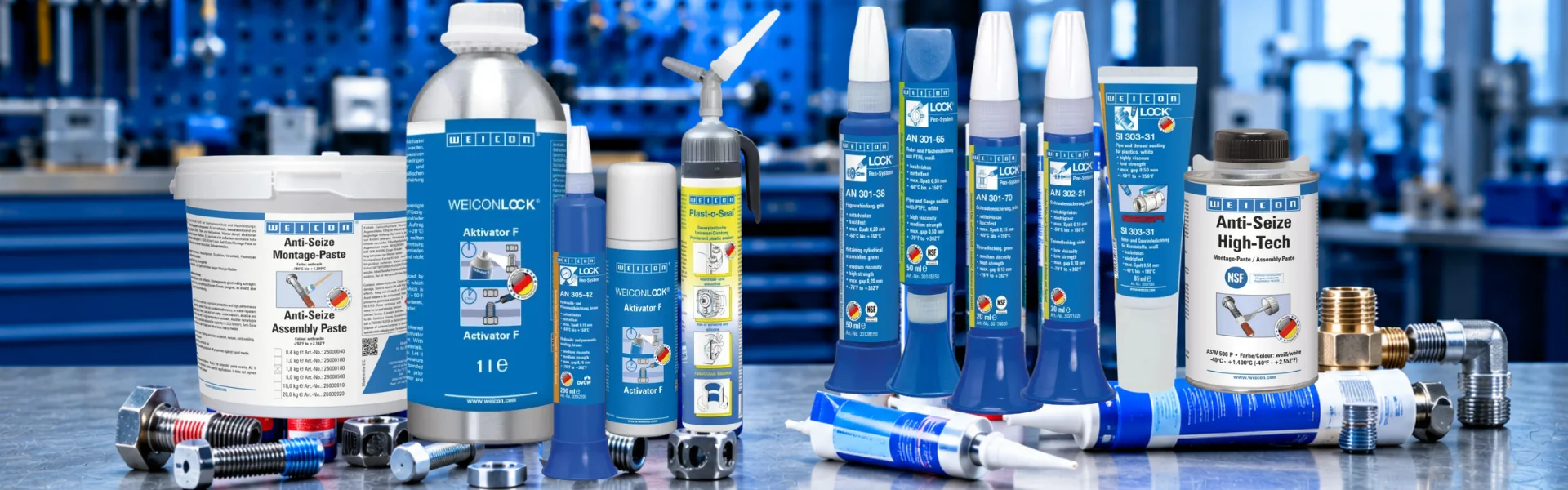
Threadlocker vs Thread Sealant: What's the Difference?
Admin
|
05 Oct 2026
|
18 min read
|
32 views
Threadlocker vs Thread Sealant: What's the Difference?
Threaded connections are used throughout industrial equipment, machinery, pipelines, hydraulic systems, pneumatic equipment, automotive assemblies and manufacturing processes.
But a threaded connection can have two very different requirements.
Sometimes the primary objective is:
Prevent the threaded fastener from loosening.
In other situations, the primary objective is:
Prevent a fluid or gas from leaking through the threaded connection.
These may sound similar, but they are not the same application.
This is where the difference between a threadlocker and a thread sealant becomes important.
A threadlocker is primarily intended to secure suitable threaded connections against loosening, particularly where vibration or changing loads may cause a screw or bolt to loosen.
A thread sealant, on the other hand, is intended to seal threaded pipes and fittings to help prevent leakage.
WEICON identifies these as separate WEICONLOCK application categories: threadlocking and sealing of threaded pipes and fittings. WEICONLOCK also includes separate categories for retaining cylindrical assemblies and flange sealing/gasketing.
Understanding the difference can help engineers, maintenance professionals, technicians, manufacturers and industrial buyers choose the right product for the job.
Threadlocker vs Thread Sealant: The Quick Answer
The simplest distinction is:
| Threadlocker | Thread Sealant |
| Secures threaded fasteners | Seals threaded pipes and fittings |
| Helps prevent loosening | Helps prevent leakage |
| Commonly used on bolts, screws and studs | Commonly used on pipe threads and fittings |
| Primarily addresses vibration and movement | Primarily addresses fluid or gas leakage |
| Selection depends on strength and removability | Selection depends on sealing requirements and media |
| Used heavily in mechanical assemblies | Used heavily in piping, hydraulic and pneumatic systems |
Both can use anaerobic curing technology, but their intended applications are different.
WEICON describes WEICONLOCK products as anaerobic one-component adhesives and sealants for metal joints. The product family is divided into application categories including threadlocking and threaded-pipe/fitting sealing.
What Is a Threadlocker?
A threadlocker is an adhesive designed to secure suitable threaded connections.
Threadlockers are commonly used on:
- Screws
- Bolts
- Stud bolts
- Threaded fasteners
- Mechanical assemblies
Their purpose is to help prevent unwanted loosening.
This becomes particularly important where equipment is exposed to:
- Vibration
- Changing loads
- Mechanical movement
- Repeated operation
WEICON explains that vibration and changing loads can cause screw connections to loosen and identifies threadlocking as an important application of its WEICONLOCK range.
How Does a Threadlocker Work?
Many industrial threadlockers use anaerobic curing technology.
"Anaerobic" means that the adhesive cures when oxygen is excluded and the product comes into contact with suitable metal surfaces.
WEICON describes WEICONLOCK as anaerobic-curing, one-component adhesives and sealants for metal joints.
The general process is:
Apply → Assemble → Exclude Oxygen → Contact with Metal → Cure
Once cured, the product helps secure the threaded connection.
Why Use a Threadlocker?
A threaded connection can loosen over time.
This can happen because of:
- Vibration
- Repeated loading
- Thermal cycling
- Mechanical movement
- Equipment operation
A suitable threadlocker can help maintain the integrity of the connection.
WEICON identifies applications in industries such as automotive, mechanical engineering and gear manufacturing.
What Is a Thread Sealant?
A thread sealant is designed to seal a threaded connection.
It is commonly used on:
- Pipe threads
- Pipe fittings
- Hydraulic connections
- Pneumatic connections
- Water systems
- Industrial piping
Its primary purpose is:
Prevent leakage through the threaded connection.
WEICON's pipe and thread sealant category includes products specifically designed for sealing threaded pipes and fittings.
How Does Thread Sealant Work?
A suitable thread sealant fills the microscopic spaces between mating threads.
The objective is to create a sealed connection.
For example:
Male pipe thread + Female fitting
↓
Apply thread sealant
↓
Assemble connection
↓
Seal threaded interface
The exact application method depends on the product.
For example, WEICONLOCK AN 305-11 is applied around the thread before the pipe thread is assembled and tightened to the desired alignment.
Threadlocker vs Thread Sealant: The Main Difference
The biggest difference is the problem you're trying to solve.
Threadlocker
The question is:
"How do I stop this threaded fastener from loosening?"
Thread Sealant
The question is:
"How do I stop this threaded pipe or fitting from leaking?"
This distinction should be the first step in product selection.
Threadlocker Is for Securing
Imagine a motor containing multiple bolts.
The motor vibrates during operation.
Over time, vibration could cause a threaded connection to loosen.
A threadlocker can be used on suitable threaded connections to help prevent unwanted loosening.
Typical application:
Bolt → Threadlocker → Component → Tighten
Thread Sealant Is for Sealing
Now consider a compressed-air pipe connection.
The threaded connection needs to contain pressure.
The problem isn't primarily that the fitting will unscrew.
The problem is:
Will air escape through the thread?
A thread sealant can be used to seal the threaded connection.
Typical application:
Pipe thread → Thread sealant → Fitting → Tighten
Can a Threadlocker Also Seal?
Some threadlocking products can provide sealing characteristics in suitable applications, but you should not automatically assume that every threadlocker is an appropriate pipe thread sealant.
Product selection should be based on the manufacturer's specified application.
WEICON separates its WEICONLOCK products into distinct application categories, including:
- Threadlocking
- Pipe and thread sealing
- Retaining
- Flange sealing/gasketing
Therefore, if the primary requirement is pipe-thread sealing, choose a product specifically designated for that application.
Can Thread Sealant Also Lock Threads?
Again, this depends on the specific product.
Some anaerobic pipe and thread sealants have strength characteristics, but their primary purpose is sealing.
For example, WEICONLOCK AN 305-11 is described as a pipe and thread sealing product with medium strength and disassembly using normal tools.
Therefore, don't select a pipe sealant simply because it has a stated strength.
Choose according to the primary application.
Threadlocker vs Thread Sealant: Where Are They Used?
Threadlocker Applications
Threadlockers can be used for suitable:
- Bolts
- Screws
- Studs
- Machine assemblies
- Gear assemblies
- Mechanical components
- Automotive components
- Industrial machinery
WEICON identifies threadlocking applications across automotive, mechanical engineering and gear manufacturing.
Thread Sealant Applications
Thread sealants can be used for suitable:
- Pipes
- Pipe fittings
- Hydraulic connections
- Pneumatic systems
- Water connections
- Industrial piping
- Energy systems
- Maintenance applications
WEICON's pipe and thread sealant range identifies applications including hydraulic and pneumatic systems, maintenance, mechanical engineering, mining, maritime, energy and oil and gas.
Threadlocker Examples
Threadlockers can vary significantly in:
- Strength
- Viscosity
- Temperature resistance
- Gap-filling capability
- Removability
WEICON's selection guidance highlights application, thread size or gap, strength and desired removability as important factors.
Low-Strength Threadlocker
A lower-strength threadlocker may be appropriate where:
- Easy disassembly is important
- Smaller fasteners are used
- Regular maintenance is expected
The exact product must be selected according to the manufacturer's specifications.
Medium-Strength Threadlocker
Medium-strength threadlockers can be useful where the connection needs reliable securing while still allowing future maintenance with appropriate tools.
For example, WEICONLOCK AN 301-43 is described as a medium-strength threadlocker.
High-Strength Threadlocker
High-strength threadlockers are intended for applications where a more permanent connection is required.
For example, WEICONLOCK AN 302-72 is described as a high-strength, high-viscosity threadlocker that is difficult to dismantle.
What Is Anaerobic Adhesive Technology?
Both threadlockers and some thread sealants can use anaerobic curing technology.
Anaerobic adhesives cure in suitable metal assemblies when oxygen is excluded.
WEICON explains that its WEICONLOCK products harden when they come into contact with metal and are deprived of oxygen.
This makes anaerobic technology particularly useful for:
- Threadlocking
- Thread sealing
- Retaining
- Flange sealing
Why Are Threaded Connections Challenging?
Threads may appear to fit tightly together, but microscopic gaps exist between mating surfaces.
These gaps can:
- Allow movement
- Permit leakage
- Provide a path for fluids or gases
- Allow vibration-related movement
Threadlocking and thread-sealing products address different problems associated with these threaded interfaces.
Threadlocker vs Thread Sealant for Mechanical Equipment
Consider a gearbox.
It may contain:
- Bolts
- Studs
- Bearings
- Shafts
- Threaded components
A bolt securing a housing may need threadlocking.
A shaft and bearing may require a retaining compound.
A pipe connection supplying lubricant may require a thread sealant.
This is why the exact application matters.
WEICON identifies threadlocking, pipe/thread sealing and retaining as separate WEICONLOCK application categories.
Threadlocker vs Thread Sealant for Hydraulic Systems
Hydraulic systems can contain pressurised fluids.
Threaded connections may therefore require appropriate sealing.
In such situations, a product specifically designed for pipe and thread sealing should be considered.
WEICON's pipe and thread sealant category includes hydraulic and pneumatic applications.
Selection should also consider:
- Pressure
- Fluid
- Temperature
- Thread material
- Thread size
- Applicable approvals
Threadlocker vs Thread Sealant for Pneumatic Systems
Pneumatic systems use compressed air or other gases.
Threaded connections need to maintain system integrity.
A suitable pipe and thread sealant can help address leakage through the threaded connection.
Again, product selection should follow the manufacturer's specifications.
Threadlocker vs Thread Sealant for Water Systems
Water systems can have very specific requirements.
Depending on the application, consider:
- Water type
- Pressure
- Temperature
- Material
- Regulatory approvals
- Drinking-water requirements
For example, WEICONLOCK AN 305-11 is described as a medium-strength pipe and thread sealing product with drinking-water approval.
Never assume that every thread sealant is automatically suitable for drinking-water applications.
Always verify the specific product approval.
Threadlocker vs Thread Sealant for Oil and Gas
Oil and gas systems can involve:
- High pressure
- Temperature
- Hydrocarbons
- Chemicals
- Vibration
Threaded connections may therefore require carefully selected sealing products.
WEICON's pipe and thread sealant category includes oil and gas among its application areas.
The actual product should be selected according to the fluid, pressure, temperature and applicable requirements.
Threadlocker vs Thread Sealant for Industrial Maintenance
Maintenance teams often encounter both types of applications.
For example:
Maintenance problem 1
A machine bolt keeps loosening.
Potential solution: suitable threadlocker.
Maintenance problem 2
A pipe fitting is leaking.
Potential solution: suitable thread sealant.
Maintenance problem 3
A bearing is slipping on a shaft.
Potential solution: suitable retaining compound.
Maintenance problem 4
A flange is leaking.
Potential solution: suitable flange sealant.
This demonstrates why maintenance teams benefit from understanding the different WEICONLOCK application categories.
Threadlocker vs Thread Sealant vs Retaining Compound
These products are often confused.
| Product | Primary Purpose | Typical Application |
| Threadlocker | Prevent threaded fasteners from loosening | Bolts, screws, studs |
| Thread sealant | Seal threaded pipes and fittings | Pipes, fittings |
| Retaining compound | Secure cylindrical assemblies | Shafts, bearings, hubs |
| Flange sealant | Seal flange surfaces | Housings, flanges |
WEICON identifies all four as separate WEICONLOCK application categories.
Threadlocker vs Thread Sealant vs Flange Sealant
A flange connection is different from a threaded pipe connection.
For example:
Threaded connection
requires consideration of:
Thread sealant
while:
Flange-to-flange connection
may require:
Flange sealing/gasketing
WEICON's WEICONLOCK system includes a dedicated flange sealing/gasketing category.
How to Choose the Right Threadlocker
When selecting a threadlocker, start with:
1. Application
What are you securing?
2. Thread size
What is the thread diameter?
3. Gap
How much clearance exists?
4. Strength
Do you need:
- Low strength?
- Medium strength?
- High strength?
5. Removability
Will technicians need to remove the fastener later?
6. Temperature
What operating temperatures will the joint experience?
WEICON specifically recommends considering application, thread size or gap, strength and colour/type selection when choosing its threadlocking solutions.
How to Choose the Right Thread Sealant
For pipe and thread sealing, consider:
1. Pipe material
For example:
- Steel
- Stainless steel
- Brass
- Plastic
2. Thread type
Identify the actual thread standard and configuration.
3. Fluid or gas
What will the connection contain?
4. Pressure
What pressure will the joint experience?
5. Temperature
What is the operating temperature?
6. Required approvals
Does the application require specific approvals?
7. Disassembly
Will future maintenance be required?
WEICON's pipe and thread sealant products vary in characteristics including viscosity, strength and disassembly behaviour.
What About Thread Sealing Tape?
Thread sealing tape, such as PTFE tape, is another method of sealing threaded connections.
It should not automatically be compared directly with anaerobic thread sealant as though they were identical products.
They are different technologies with different application methods and characteristics.
WEICON also offers Thread Sealing Cord DF 175, a PTFE-based thread sealing product designed for suitable metal and plastic threads. WEICON describes it as reversible and suitable for flexible applications.
Therefore, the choice may be between:
- PTFE sealing tape
- PTFE sealing cord
- Anaerobic thread sealant
- Other approved sealing systems
depending on the application.
Thread Sealant vs PTFE Tape
| Feature | Anaerobic Thread Sealant | PTFE Thread Sealing |
| Application | Applied as liquid | Applied as tape/cord |
| Curing | Selected products cure anaerobically | Does not cure like an anaerobic adhesive |
| Sealing | Seals suitable threaded connections | Seals suitable threaded connections |
| Reversibility | Depends on product | Can be reversible depending on system |
| Application process | Apply to thread and assemble | Wrap/apply according to product instructions |
| Selection | Based on application and technical requirements | Based on thread, media and application requirements |
The correct solution depends on the system and manufacturer's instructions.
Does Threadlocker Seal a Bolt?
A threadlocker can help secure a threaded fastener and some products may also contribute to sealing the thread interface.
However, if your primary requirement is pipe-thread sealing, choose a product specifically designed and specified for thread sealing.
This distinction is particularly important in pressurised systems.
Does Thread Sealant Prevent Bolts From Loosening?
Some thread sealants have strength characteristics, but their intended function is sealing.
If your primary problem is:
"The bolt keeps loosening."
then a product specifically designed for threadlocking is generally the more appropriate category to investigate.
Can I Use the Same Product for Both?
Not automatically.
Some anaerobic products may have overlapping properties, but product selection should always follow the manufacturer's intended application.
WEICON's own WEICONLOCK range separates products by application category and type.
This is a good reason to avoid choosing products simply based on colour or viscosity.
Why Product Selection Matters
Within the WEICONLOCK range, products differ in:
- Application
- Strength
- Viscosity
- Colour
- Temperature characteristics
- Gap suitability
- Removability
WEICON's product-selection guidance specifically highlights these differences.
Therefore:
Don't choose an anaerobic product simply because it is available. Choose it because it matches the application.
Surface Preparation
Surface preparation matters for both threadlockers and thread sealants.
For optimum results, WEICON recommends that mounting parts be degreased and cleaned. It also notes that cleaner surfaces generally produce better results.
A general process is:
Inspect → Clean → Degrease → Apply → Assemble → Cure
The exact preparation should follow the product's instructions.
How to Apply a Threadlocker
A typical process is:
Step 1
Clean the threaded components.
Step 2
Check the thread condition.
Step 3
Apply the appropriate amount of threadlocker.
Step 4
Assemble the components.
Step 5
Tighten to the specified torque.
Step 6
Allow the product to cure according to its technical documentation.
WEICON's technical documentation provides specific application instructions for individual threadlocking products.
How to Apply a Thread Sealant
A typical process is:
Step 1
Clean and prepare the threads.
Step 2
Apply the appropriate sealant around the thread.
Step 3
Assemble the pipe and fitting.
Step 4
Tighten to the desired alignment and requirements.
Step 5
Allow the sealant to cure as specified.
For WEICONLOCK AN 305-11, WEICON instructs users to apply the product around the thread, assemble the pipe thread and tighten it to the desired alignment.
Don't Overapply Threadlocker or Thread Sealant
More product does not automatically mean better performance.
Excessive application can:
- Increase mess
- Increase curing time
- Increase material consumption
- Create unnecessary cleanup
- Potentially interfere with the assembly
Use the quantity and application method specified for the particular product.
Threadlocker vs Thread Sealant: Common Mistakes
Mistake 1 — Using Threadlocker on a Pipe Connection
If the primary requirement is sealing a pipe thread, choose a product specified for pipe/thread sealing.
Mistake 2 — Using Thread Sealant to Solve a Vibration Problem
If a bolt is loosening due to vibration, investigate a suitable threadlocker.
Mistake 3 — Ignoring the Fluid
For pipe sealing, always identify what the connection contains.
Mistake 4 — Ignoring Pressure
A low-pressure application and a high-pressure industrial system should not automatically use the same product.
Mistake 5 — Ignoring Temperature
Temperature can influence curing and long-term performance.
Mistake 6 — Ignoring Thread Size
Thread size and gap can influence product selection.
WEICON specifically includes thread size and gap in its threadlocker selection guidance.
Mistake 7 — Choosing Only by Colour
Colours can help identify products, but they should not be the only selection criterion.
WEICON notes that its product colours are useful for identification and visual quality inspection, while application, strength and other characteristics are also important.
WEICONLOCK Colour System
WEICON uses colour coding to help distinguish different application categories.
According to WEICON:
Yellow
Locking of threads and stud bolts
Red
Sealing of threaded pipes and fittings
Blue
Retaining cylindrical assemblies
Green
Flange sealing/gasketing
This can make product identification easier in workshops and production environments.
However, always verify the exact product label and technical documentation.
Threadlocker vs Thread Sealant: Quick Decision Tree
Use this simple decision process:
Is your connection a threaded fastener?
YES
↓
Is the problem loosening?
YES → Investigate a threadlocker
Is your connection a pipe or fitting?
YES
↓
Is the problem leakage?
YES → Investigate a thread sealant
Is it a shaft, bearing or cylindrical assembly?
YES → Investigate a retaining compound
Is it a flange or housing surface?
YES → Investigate a flange sealant
This mirrors the application-based separation used within the WEICONLOCK product family.
Threadlocker vs Thread Sealant Comparison
| Factor | Threadlocker | Thread Sealant |
| Primary purpose | Prevent loosening | Prevent leakage |
| Main connection | Fasteners | Pipes/fittings |
| Typical components | Bolts, screws, studs | Pipe threads, fittings |
| Main concern | Vibration/movement | Fluids/gases |
| Strength selection | Very important | Important |
| Sealing requirement | Secondary depending on product | Primary |
| Removability | Important | Important |
| Thread size/gap | Important | Important |
| Temperature | Important | Important |
| Chemical/media compatibility | Important | Critical |
| Typical industry | Mechanical engineering | Piping/process systems |
| Example WEICONLOCK category | Threadlocking | Pipe & thread sealing |
Which One Should You Buy?
Use this simple rule:
Buy a threadlocker when:
- A bolt is loosening
- A screw needs securing
- A stud needs locking
- Vibration is causing fastener movement
- You need controlled threadlocking
Buy a thread sealant when:
- A pipe thread is leaking
- A fitting needs sealing
- A hydraulic connection needs sealing
- A pneumatic connection needs sealing
- A threaded connection needs to contain fluid or gas
WEICONLOCK: One Product Family, Different Applications
One of the advantages of the WEICONLOCK range is that it covers multiple anaerobic applications.
WEICON identifies four main categories:
1. Threadlocking
For securing threaded fasteners.
2. Pipe and Thread Sealing
For sealing threaded pipes and fittings.
3. Retaining
For suitable cylindrical assemblies.
4. Flange Sealing and Gasketing
For suitable flange and housing applications.
This makes WEICONLOCK particularly useful as a family of solutions rather than treating every anaerobic product as interchangeable.
Example: Choosing the Right Solution
Imagine a manufacturing plant has three problems.
Problem A
A conveyor bolt repeatedly loosens.
Requirement: Prevent loosening.
Product category: Threadlocker.
Problem B
A compressed-air fitting is leaking.
Requirement: Prevent leakage.
Product category: Pipe/thread sealant.
Problem C
A bearing is slipping on a shaft.
Requirement: Secure cylindrical assembly.
Product category: Retaining compound.
These are three different problems requiring three different product-selection approaches.
When to Ask for Technical Assistance
You should seek technical guidance when the application involves:
- High pressure
- Extreme temperature
- Aggressive chemicals
- Critical machinery
- Safety-critical connections
- Drinking-water systems
- Special regulatory requirements
- Unknown materials
- Unusual thread sizes
- Large gaps
- Complex operating conditions
WEICON provides product-selection tools and encourages users with specific applications to contact its sales team for assistance.
For Spleca customers, providing detailed application information can also help narrow down the appropriate product.
Information to Provide When Asking for a Recommendation
When contacting Spleca about a threadlocker or thread sealant, provide:
Application:
Component:
Thread type:
Thread size:
Material:
Fluid/gas:
Pressure:
Operating temperature:
Gap:
Vibration:
Required strength:
Required removability:
Current product:
Photos:
The more information you provide, the easier it becomes to identify a suitable product.
Frequently Asked Questions
What is the difference between a threadlocker and a thread sealant?
A threadlocker is primarily used to secure suitable threaded fasteners against loosening, while a thread sealant is primarily used to seal threaded pipes and fittings against leakage. WEICON treats these as separate WEICONLOCK application categories.
Is threadlocker the same as thread sealant?
No. Although both can use anaerobic technology, they are designed for different primary applications.
Can I use threadlocker on pipe threads?
Only if the specific product is designed and specified for that application. If your primary requirement is pipe-thread sealing, use a product specifically designated for pipe and thread sealing.
Can thread sealant prevent bolts from loosening?
Some products may have strength characteristics, but thread sealant should not automatically be substituted for a threadlocker. Select the product according to its intended application.
What is an anaerobic threadlocker?
It is a threadlocking adhesive that cures in suitable metal assemblies when oxygen is excluded. WEICON describes WEICONLOCK as an anaerobic-curing one-component adhesive and sealant system.
What is anaerobic thread sealant?
It is an anaerobic sealing product designed for suitable threaded connections, particularly pipe and fitting applications.
What is the best threadlocker?
There is no universal best threadlocker. Selection depends on thread size, gap, required strength, temperature, material and removability.
What is the best thread sealant?
The correct product depends on the thread, materials, fluid or gas, pressure, temperature, required approvals and disassembly requirements.
What colour is threadlocker?
Colour depends on the product. Within WEICONLOCK's application identification system, yellow is used for locking threads and stud bolts, while red identifies sealing of threaded pipes and fittings.
What does red WEICONLOCK mean?
Within WEICON's colour-coded application system, red identifies products for sealing threaded pipes and fittings.
What does yellow WEICONLOCK mean?
Yellow identifies products for locking threads and stud bolts within WEICON's application classification.
Is WEICONLOCK suitable for industrial maintenance?
Yes, WEICON identifies threadlocking and thread-sealing solutions among applications for maintenance and industrial equipment.
Can thread sealant be used for hydraulic applications?
Some products are specifically intended for suitable hydraulic applications. Always verify the product's technical documentation against the hydraulic fluid, pressure, temperature and materials.
Can thread sealant be used for drinking water?
Only use a product with the required approval for the specific drinking-water application. For example, WEICONLOCK AN 305-11 is described by WEICON as having drinking-water approval.
How do I choose between threadlocker and thread sealant?
Ask one question first:
Are you trying to stop a fastener from loosening, or are you trying to stop a threaded pipe connection from leaking?
Loosening → Threadlocker
Leakage → Thread Sealant
Conclusion
Threadlockers and thread sealants may both be used around threaded connections, but they solve different problems.
Threadlocker
Purpose: Secure threaded fasteners.
Main problem: Loosening.
Typical applications: Bolts, screws and studs.
Thread Sealant
Purpose: Seal threaded pipes and fittings.
Main problem: Leakage.
Typical applications: Pipe threads, fittings, hydraulic and pneumatic connections.
Both can be based on anaerobic curing technology, but the correct product depends on the application.
WEICON's WEICONLOCK range makes this distinction particularly clear by separating products into four application categories:
Threadlocking → Pipe & Thread Sealing → Retaining → Flange Sealing/Gasketing.
When choosing a product, don't rely solely on colour, strength or viscosity.
Consider:
Application + Material + Thread Size + Gap + Temperature + Media + Pressure + Strength + Removability
For Australian manufacturers, maintenance teams, engineers, mechanical contractors and industrial businesses, selecting the correct threadlocker or thread sealant can help improve the reliability of threaded connections and reduce avoidable maintenance issues.
Need help selecting the right product?
Explore Industrial Automation Products